I just want you all to know that I love you, each and every one of you. You are all like bits of sunshine and flowers and rainbows. You’re all so…beautiful!
That’s because at the ripe middle age of 45, I just had my wisdom teeth out, and I’ve spent much of this weekend seriously bent on pain medications. In fact, I’m only just now stepping down from the truly groovy stuff to good old turbo-charged Motrin 800s.
While I’m under the influence of all these yummy As and Bs, I must make a confession: I am, in fact, a coward, of the insect nerve and rubber backbone variety, to borrow a phrase from the late, great George Fitch. I can stand anything but pain and temptation. For the past two and half decades, I’ve been convinced that this would be one of the most horrible, painful experiences of my life and avoided it religiously.
It didn’t help when the doctor walked into the room, did a double take, and said, “You’re not seventeen. What are you doing here?”
And yet, now I’m embarrassed because it really wasn’t all that bad – to the point where as I come out of my codeine-induced euphoria, I dimly wonder what in the world I was worried about.
While it is not uncommon for folks my age to undergo this procedure, it is apparently medical fact that a young person has an easier time than, well, a youngish, in-shape-for-a- man-my-age kind of middle-aged rock and roller.
The problem is, my memories of my elder siblings’ teen wisdom teeth experiences were not good ones. My brother had the worst time of it. He not only got the Army dentist – my brother would argue that army would have been the Wehrmacht – complete with the boot-on-the-chest-and-pliers treatment, he was allergic to nearly all the pain medications. To add insult to injury, he also got a hideous infection that lingered throughout most of that summer.
As he liked to describe it -- especially during meals – he spent the summer, “Draining the puss from my jaw like someone milking venom from a rattlesnake.”
My sisters did not seem to fare much better, although they didn’t have to deal with Sir Lawrence Olivier saying, “Is it zafe yet?” and somehow escaped infection.
So my attitude for the last quarter century has been, “Why would I willingly pay good money to submit myself to such torture and lose a weekend that I could be doing something else far more fun?”
Alas, there finally comes a day when one can no longer put it off. Happily, though, the procedures and the drugs have improved over the years. They gave me something called twilight anesthesia, which rendered the forty-five minutes the doctor spent rooting, sawing, yanking, and sewing, completely forgotten. In fact, he could have replaced my head with a red cabbage – and may have, for all I know -- and I wouldn’t have noticed until today. When I awakened, I was so shot full of good stuff I didn’t feel so much as a twinge of anything for about five hours. I had time to eat something soft, cool and sloppy, pound a pain pill, curl up under a blanket with my Hefty bag of ice sitting on my face, and drift pleasantly into the mindless, brain-dissolving hypnosis of daytime television.
It wasn’t the best way to spend a weekend, but to be fair I’ve suffered through worse hangovers – upon which I willingly spent good money and lost entire weekends – and insurance didn’t even cover them.
When people are talking about what makes the Lowcountry special, “sense of place” is a phrase that gets tossed around a lot.
Sense of place is difficult to define. Most residents would agree though, that whatever “sense of place” is, the Lowcountry has it. And we want to keep it.
There’s a similar concept that is less familiar, but just as important: integrity of place. Integrity of place is so important, in fact, that it is the first of the Thirteen Principles of Geotourism.
Geotourism is a term coined by the folks at the National Geographic Center for Sustainable Destinations. They define it as “tourism that sustains or enhances the geographical character of a place – its environment, culture, aesthetics, heritage, and the well-being of its residents.”
They also developed a set of guidelines to help communities become better places to visit – while at the same time becoming even better places to live. I see it as being like a Ten Commandments of Tourism. Or maybe it’s more like the Seven Habits of Highly Effective Tourism Destinations.
Whatever you want to compare it to, communities that make a commitment to the Thirteen Principles of Geotourism are, in theory, on the road to becoming more sustainable, more compassionate and more just, while also -- we mustn’t forget this part – making more money.
The Thirteen Principles are found in a document called the Geotourism Charter, which was drafted by National Geographic in hopes that it would be adopted by forward-thinking governments. It is my hope that the Geotourism Charter will be adopted by all of the counties in the Lowcountry region, starting with Beaufort County.
Here’s how the proposed Beaufort County charter would read:
Geotourism Charter of Beaufort County, South Carolina
WHEREAS the geotourism approach is all-inclusive, focusing not only on the environment, but also on the diversity of the cultural, historic, and scenic assets of Beaufort County,
WHEREAS the geotourism approach encourages citizens and visitors to get involved rather than remain tourism spectators, and
WHEREAS the geotourism approach helps build a sense of regional identity and pride, stressing what is authentic and unique to Beaufort County,
THE UNDERSIGNED parties to this Agreement of Intent commit to support these geotourism principles, to sustain and enhance the geographical character of Beaufort County—its environment, culture, aesthetics, heritage, and the well-being of its residents:
Integrity of place: Enhance geographical character by developing and improving it in ways distinctive to the locale, reflective of its natural and cultural heritage, so as to encourage market differentiation and cultural pride.
International codes: Adhere to the principles embodied in the World Tourism Organization’s Global Code of Ethics for Tourism and the Principles of the Cultural Tourism Charter established by the International Council on Monuments and Sites (ICOMOS).
Market selectivity: Encourage growth in tourism market segments most likely to appreciate, respect, and disseminate information about the distinctive assets of the locale.
Market diversity: Encourage a full range of appropriate food and lodging facilities, so as to appeal to the entire demographic spectrum of the geotourism market and so maximize economic resiliency over both the short and long term.
Tourist satisfaction: Ensure that satisfied, excited geotourists bring new vacation stories home and send friends off to experience the same thing, thus providing continuing demand for the destination.
Community involvement: Base tourism on community resources to the extent possible, encouraging local small businesses and civic groups to build partnerships to promote and provide a distinctive, honest visitor experience and market their locales effectively. Help businesses develop approaches to tourism that build on the area’s nature, history and culture, including food and drink, artisanry, performance arts, etc.
Community benefit: Encourage micro- to medium-size enterprises and tourism business strategies that emphasize economic and social benefits to involved communities, especially poverty alleviation, with clear communication of the destination stewardship policies required to maintain those benefits.
Protection and enhancement of destination appeal: Encourage businesses to sustain natural habitats, heritage sites, aesthetic appeal, and local culture. Prevent degradation by keeping volumes of tourists within maximum acceptable limits. Seek business models that can operate profitably within those limits. Use persuasion, incentives, and legal enforcement as needed.
Land use: Anticipate development pressures and apply techniques to prevent undesired overdevelopment and degradation. Contain resort and vacation-home sprawl, especially on coasts and islands, so as to retain a diversity of natural and scenic environments and ensure continued resident access to waterfronts. Encourage major self-contained tourism attractions, such as large-scale theme parks and convention centers unrelated to character of place, to be sited in needier locations with no significant ecological, scenic, or cultural assets.
Conservation of resources: Encourage businesses to minimize water pollution, solid waste, energy consumption, water usage, landscaping chemicals, and overly bright nighttime lighting. Advertise these measures in a way that attracts the large, environmentally sympathetic tourist market.
Planning: Recognize and respect immediate economic needs without sacrificing long-term character and the geotourism potential of the destination. Where tourism attracts in-migration of workers, develop new communities that themselves constitute a destination enhancement. Strive to diversify the economy and limit population influx to sustainable levels. Adopt public strategies for mitigating practices that are incompatible with geotourism and damaging to the image of the destination.
Interactive interpretation: Engage both visitors and hosts in learning about the place. Encourage residents to show off the natural and cultural heritage of their communities, so that tourists gain a richer experience and residents develop pride in their locales.
Evaluation: Establish an evaluation process to be conducted on a regular basis by an independent panel representing all stakeholder interests, and publicize evaluation results.
I’d prefer that the Lowcountry not have to consider itself as a tourism destination. But the reality is that we are, and it’s not enough just to cope with it. We need to embrace the fact that we are a tourism destination if we are to shape our destiny as a sustainable community,
“According to my large and diverse group of FB friends, either the sky has just fallen or the kingdom has just come. It’s still dark outside, so I can’t be sure who’s right.”
This was my Facebook update the morning after last week’s big healthcare reform vote. While plenty of my updates are met with resounding indifference, this one garnered a whopping 85 comments. Eighty-five! And lots of them weren’t even made by me. I’m not sure who was more passionate that day – the fallen sky crowd or the kingdom comers. But lots of folks – and I count myself among them – were more circumspect, neither mourning nor rejoicing. Just curious, cautious… and confused.
I learned a lot that day, as FB friends posted articles, explained finer points of the bill as they understood it, shared their personal adventures in healthcare – both American and European – aired their fears and frustrations, and offered each other support and advice. The most remarkable fact about this long and winding FB thread was that, despite the strong and varied opinions represented, there were no angry attacks waged… no invective hurled. I repeat: An extremely diverse group of people from various backgrounds and political affiliations managed to have a serious debate – about healthcare reform! – and for 85 whole comments, civility reigned. Facebook felt like a blessed space that day.
Oh, it wasn’t perfect: One of my favorite FB friends – actually, one of my favorite friends, period – was particularly upset about the vote, and upset with me for not being upset, and… that upset me. My mother, who believes the Republic is now dead, was also disappointed in me for my failure to panic or despair. I hate letting down the people I love – people who count on me to think and feel like they do. But here’s the thing: Try as I may, I just can’t get worked up, one way or the other, about this healthcare bill. It is what it is – for better or worse (both, I suspect) – and I don’t think anybody really knows what that means yet, or how it will all unfold. Oh, plenty of people think they know, but I’m not buying it. There are simply too many smart, decent people out there espousing too many opposing “truths.” So I’m in wait-and-see mode. And you know what? It’s peaceful here.
The comment that best expressed my own frame of mind that day (and still does) was posted by a dear old friend who has shared much wisdom with me over the years:
“It was a day, like any other day, full of sound and fury signifying nothing. Another congress will come and go, another bill will change this one and another one will come that offers more or less. Presidents come and go as do Popes and Preachers and Walruses on flows of ice, which comes and goes as well….”
He went on in that poetical vein, then added a biblical flourish: “Set your sights on things above, not on earthly things.”
Spectacular advice, I thought. In fact, I was already following it. The Sunday night of the healthcare vote, while most people I knew were riveted to their TV sets, following the action in Congress with all the fervor, anxiety and competitiveness usually reserved for a major national sporting event – but little of the humor and good will toward the opposing team – I was off listening to a magnificent local choir perform Mozart and Handel under the masterful direction of Charles Frost. (Thanks for that, Charlie!) I came sailing home on a sea of inspiration, and, sure, the TV was on… and I heard the demagoguery… and I heard the anger… and I heard the profanity… and it just didn’t matter.
Listen, I’m not saying the healthcare vote didn’t matter. Of course it did. And it does. And it will. But the path leading up to that vote has been so very “earthly,” in the worst sense of the word, that trying to separate each party’s good intentions (which I believe they both have) from pure, power-grabbing politics (ditto) has become impossible for me. The same goes for separating truth from propaganda. So I’ve stopped trying. The poor ol’ Serenity Prayer has become a cliché in our sloganeering, 12 Step culture, but I think it bears repeating – again – because it’s actually quite profound: “God grant me the serenity to accept the things I cannot change; courage to change the things I can; and wisdom to know the difference.” At this point, the direction of healthcare reform seems to fall into that first category – things I cannot change. And only time will tell if I’d even want to. (I know…. I know… By then it might be too late. I hear ya, Mom. Really I do.)
Obviously, completely checking out on politics would be a lowdown, lazy thing to do. The shaping of public policy is crucial to the welfare of a nation, and as citizens, we all have a responsibility to stay informed about what’s happening in Washington and, certainly, to exercise our influence at election time. Sometimes, if so compelled, we may even have a responsibility to take action beyond that.
But what we don’t have to do – ever – is engage in this great national bickering contest, the one that has turned us into a country full of self-righteous, arrogant, rabble-rousing jerks. Myself included. A friend of mine recently threw out a colorful term I hadn’t heard before: Thought Porn. He theorized that many of our political blogs, and especially our nighttime cable news shows, specialize in this Thought Porn, which, much like porn "classic,” only serves to stroke our egos, stoke our basest instincts… and turn us into addicts.
(If you’re feeling really angry at that characterization – or really defensive – you may have a problem. Try turning off Fox or MSNBC for a week. The first few nights will be painful, but you won’t believe how much better you’ll feel after the initial cold turkey. I speak from experience.)
I know that for some of you, this will seem like a very lightweight essay, unbefitting a serious topic like healthcare reform. I’ll have disappointed you; you’ll think me apathetic, or worse… cowardly. But y’all know I’ve always been willing to take my hits… that I put myself out there when the spirit moves me. In this case, it just ain’t moving me. Not the way you want it to. I can assure you that I’m not avoiding conflict, here; I am, as always, saying exactly what I believe… and exactly what I believe is most worth saying.
It was an FB friend who encouraged me to write about the healthcare debate at all. (He was part of my 85-comment discussion thread.) “You should write about the healthcare stuff,” he said. “And make it funny!”
Well, I’m not sure there’s much that’s funny about healthcare reform (though there’s certainly been plenty of absurdist humoron display throughout). But, in the end, I suppose I do see this whole thing in comic terms – in the Greek sense of the word. As in “happy ending”… as in, “it’ll all turn out okay.” Not just healthcare reform… but all of it. Everything. How can I be so optimistic? Well, that’s what happens when you start setting your sights on “things above.” And ironically, I keep tripping over “earthly things” that fuel that perspective, too. For instance: After playing hard-to-get for weeks, the azaleas are finally blooming… My beautiful baby niece, Ellie, is sitting up on her own (she was only born yesterday!)… My choir actually managed to learn Schubert’s daunting Mass in G… in Latin (come hear us sing it Thursday night at First Pres!)… I participated in a friendly debate about healthcare reform…
Okay, so maybe I tend to spot semi-miraculous connections where others see random chaos. Do those connections exist only in my mind? It’s quite possible. But as Easter comes again, with all its mystery and meaning and paradox, I can’t help remembering the words of the late, great wizard Dumbledore in the final Harry Potter book: “Of course it is happening inside your head, Harry, but why on earth should that mean it is not real?”
Think about it. And while you’re at it, try setting your sights on things above. It’s good for your health.
There’s no better editor than Margaret Evans. It’s not just that she’s such a talented writer and imager; (in my selfish case) it’s that she lets me go for weeks without pushing me to write and so my inherent laziness can continue to exceed its own expectations. But, here I am again and with a warm acknowledgement to those who’ve told me you miss my articles. That’s a very nice thing to hear.
Another spring
This long Lowcountry winter shows signs of a welcome exit and another perfect spring seems near at hand. Rebirth, rejuvenation, recalibration, recreation (in both senses of the word) and renaissance but no regret; no resistance; no recalcitrance. This is the one kind of change we can believe in.
Our wonderful house with its staggering views on the marshes may be worth less than we paid for it, but those marshes are still the flyway, feeding place and marshaling yard for thousands of magnificent shorebirds. They are the encampments of millions of ghost and fiddler crabs; arranged as if in arrays of miniature armored divisions ready to film an epic scene in some Star Wars prequel. They are the place where even the ocean reaches its limits; a place where no two tides and no two views are ever the same. Kind of gives a whole new meaning to being under water.
What’s up with……?
How come the contractors working on the new span of the McTeer Bridge and the widening of highway 802 seem to be making incredible progress while the contractors widening parts of the highway to Charleston seem suspended somewhere back in 2004?
And, how about Mayor Billy and the Beaufort City Council; over a year since they were elected and not a breath of scandal; not a hint of discontent or animosity. They just seem to be doing what they said they would. Wow.
And now, to embarrass a friend
Anyone who attended the Beaufort International Film Festival has got to be feeling great. It was a home run. It was all it could have been, what with the magnificent Blythe Danner and Michael O’Keefe and our own Pat Conroy and the nearly 4,000 of us who were at the opening and the gala and the films.
My friend, Ron Tucker, is the passion and the vision and the dedication that brought it all together. His mission was to create the Beaufort Film Society, which he did last year and, through it, effect the direction, management and execution of the Beaufort International Film Festival, and he accomplished that with brilliance.
With the precision and focus and clarity of the Marine that he is (he’s “retired” from the Corps but as any Marine will tell you, they don’t retire) Ron elevated the process and the participation and the results. Of course, he did not do it alone. There was a remarkable team of professionals and volunteers who helped pull it all off.
Ron’s “Chief of Staff”, Rebecca Berry, press relations guru Lanier Laney and PR whiz, Bruce Doneff are three of them. He’s thanked them and everyone else who made the festival such a success. We, all of us, owe them our thanks for a wonderful achievement.
So, with beginnings of a spring such as this one, never mind that extra long winter of our marginal and chilly discontent. Never mind the boring pundits with their incessant daily ramblings about how bad things are or still could be.
All we need is a few months of consumer confidence, in a row. Can anyone tell me why it can’t start in Beaufort?
Beaufort teacher Josefina Blanc discusses her native country of Chile – why she loves it, why she left it, and what she’s doing to help it, post-earthquake.
The first thing you notice about my friend Josefina Blanc is that she looks more like a big city fashion model than a small town Spanish teacher. (We’re talking really tall and really gorgeous.) The next things you’ll notice are her sultry South American accent, her marvelous sense of humor, and her formidable intelligence. And despite this enviable embarrassment of attributes, you‘ll find her impossible not to like.
Josefina, who lives in Beaufort with her husband and young son, and teaches Spanish at Battery Creek High, grew up in Santiago, Chile. Most of her family is still there. Though she left the beautiful, volatile country over a decade ago, it is still very much at the heart of who she is. Josefina spoke with me recently about her childhood, the complicated country she loves and left, the day the earth shook (again), and what happens next.
Josefina, when and why did you leave Chile?
I left in November 1998, days after Augusto Pinochet was arrested in the UK for human rights violations. The reason I left is not unrelated to that event. After growing up in a military dictatorship, I realized that it would take my country decades to recover socially and politically. I felt a bit impotent back then, I wanted to live my life in a less restrictive way, so I left the country in what I often call a self-exile, to see if I could find a wider range of opportunities and experiences in New York City, where I lived for 10 years.
Most of your family is still in Chile, correct?
My father, sisters, nephew and nieces all still live in Santiago, the capital. That’s where we were born and grew up. My brother lives in Austin, TX, but he is only there for his PhD, and will soon return to Chile.
Whenever you speak of your childhood in Chile, I sense conflicting emotions…
Growing up in Chile was a wonderful mix of experiences. Given that my mother was Argentine, half of my family still lived and lives on the other side of the Andes, so we had a very diverse childhood, compared to most Chileans, but also a very “Southern Cone”-oriented one; everything happened for me between the different accents, oceans and those gigantic, shaky mountains. Growing up in the late seventies meant that I grew up in a military dictatorship. I always share the tale with my friends that until I turned 15 or so, I thought Pinochet, Ronald Reagan and John Paul II had always been in charge of the world. I say this as a symbol of what the prevalent culture was in my community: capitalist, ultra-conservative and Opus Dei Catholic. Due to its geographic location, Chile was also a very isolated community. For instance, I never met an African American in person until I turned 18 years old and traveled to Chicago. Also, Chile was the last country in the world to legalize divorce, in 2006. But you had the best of that culture, as well: strong families, old traditions, reliable institutions, and social order (which is not a minor achievement in Latin America).
Speaking of which, Chile has had such a volatile history. How were things shaping up there before this tragedy? How big a setback will it be?
It will without a doubt be a huge setback in the social arena. Since Pinochet left power in 1989, the center left has invested twenty years and billions of dollars in social policies and infrastructure that were profoundly affected over the course of 2 and 1/2 minutes. This sets back education in rural areas as well as national and international commerce, which is highly dependent on modern highways bridges, ports and airports. As you may know, Chile’s largest export, copper, was immediately affected; even though the mines are mainly in the north (away from the epicenter), the price went up considerably within the first few hours of the day. That’s just a small example, but the scale of the human and material damage escapes our ability to describe it. Like the earth, there are infinite layers, emotional and physical, that will be very hard to reconstruct.
I can’t imagine the anxiety you must have suffered the day of the earthquake! I assume you couldn’t get in touch with anybody for a while…
My friend Cabell woke me up with a phone call telling me there had been an earthquake in Chile, to which I sweetly replied, “Oh, not to worry, they happen ALL THE TIME.” He said it had been a pretty serious one, and then I became very worried. I lived through the 7.5 earthquake of 1985, and it had been the last extremely damaging one, so I knew that if it had made the news in Beaufort, SC, it was probably really bad news. But I never imagined it was an 8.8! I couldn’t reach anyone by phone, and since I’d just moved into a new home, I didn’t have cable or Internet access. So I went to the coffee shop to use theirs. As soon as I got to Java City & News, I saw the earthquake all over CNN and the other channels, which didn’t make me any more calm. I waited there and heard from my family that they were OK before noon. Nonetheless, it took me a good 12 hours before I realized the scale of the quake that had hit them in Santiago. I just assumed Santiago hadn’t been hit hard when I found out that the epicenter was so far down in the south, but the reality is that it was a massive earthquake in 80% of the country.
According to estimates, over 500,000 homes were lost or badly damaged in the earthquake. You have set up a fund to raise money for your personal friends who are among that number. Are there many?
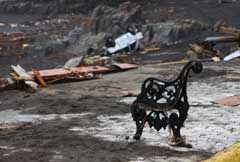
I have three friends who lost their homes, but one couple in particular, in Talca, is probably the most affected, since this was one of the worst hit areas in the region. Many of their friends and acquaintances are also homeless, and electricity and water services hadn’t reached them yet after a week. They have found someone to stay with by now and they are just grateful to be alive. One of them is a dear friend of mine, an artist, whom I grew up with since birth; we are the closest thing to siblings there is. It is particularly sad that he lost his home because he had just gotten married last December, so he was just getting started. (Plus, I keep thinking about how much it sucks to lose all of those very helpful wedding gifts, etc.)
How have your own family members fared?
Very well, but still going through the shock and the fear of the constant replicas, and the profound sadness of their many friends and acquaintances who either lost their homes, their lives, or the lives of their young children. But it is true that what doesn’t break you makes you stronger. I am so proud of the Chilean people, we are truly made of steel, and we still have the very old school value of solidarity. We are a famously poor nation (no matter what you hear on TV) with avery sneaky streak. You might have heard about all the looting that was going on within 10 hours of the quake? People panic and take advantage of the situation; they were even stealing flat screen TV’s! But also last Friday, when we had a national Telethon, not only did they double of their monetary goal, but a huge number of looters started returning the stolen goods… I mean, that is Gabriel García-Marquez kind of stuff! Only in Chile.
Chile just inaugurated a new president, Sebastian Piñera. Not exactly a “soft opening” for his presidency! Do you think he’s got what it takes to manage this crisis and get the country back on its feet?
Absolutely. He is a center-right politician and also one of the most aggressive impresarios the country has ever seen. If there is a spirit of entrepreneurship, he is one of the people who best embodies it, for better and for worse. Crisis is never a good time to play politics, but if I were to point anything out, it would be that he called immediately that Saturday morning to President Michelle Bachelet to take the Armed Forces on the street to maintain civil order. It took her 48 hours to make that decision instead, and the military only arrived in small numbers on Sunday night. We all suffered the consequences of that delay. She was probably trying to be wise, since Chile has such a painful history with the military, but she had no political risk in making this decision, being a socialist president who was one her way out, the daughter of an ex-tortured military man, and the Secretary of Defense, herself, for a whole term. Piñera and Bachelet both showed their character with these gestures. It is my suspicion and my hope that the new president is the kind that will think with efficiency and the reconstruction of the people and the economy in mind, above politics (if not beyond).
So, how can our readers help you help your friends in Chile?
People can donate online through PayPal (by clicking HERE) or by joining my Facebook group called: “CHILE: help me raise funds for my homeless friends after the earthquake.” They may also contact me at
This e-mail address is being protected from spambots. You need JavaScript enabled to view it
about sending a check. If they would rather give an institutional donation, please support http://www.untechoparachile.cl/. It is a very efficient and legitimate organization that has been around for years in Chile fighting poverty. They are building houses for the hundreds of thousands of homeless right now. I just chose to help directly the ones I know.
Editor’s Note: Kim Cech of Yoga Chandra has also generously offered to donate the proceeds of her March 20th event, Awaken!, to Josefina’s cause. For more information about that event, go here.
Photographs of Talca, Chile by Hector Labarca Rocco
That’s because the Three Rs – real estate, retirement and related industries – are no longer the Most Valuable Players in our local economy. At least for the time being.
They are still in the game, of course, but they are expected to spend the next few innings either sitting on the bench or moping around in the outfield.
So in this time of tenuous economic recovery, what are we going to do while we’re waiting for the Three Rs to get a second wind? I say, play T-Ball! And in this case, the T stands for tourism.
T-Ball is rinky-dink compared to baseball, I know. Likewise, as a profession, tourism isn’t particularly glamorous or grownup-sounding. Truthfully, have you ever heard a child say that when they grow up they want to be a ... tour guide?
The problem is that in our current power structure, occupations related to tourism suffer from a lack of status. What evidence do I have? Ask yourself, have you ever read or heard phrases like “powerful real estate developer” or “influential investment banker”? I’d guess you probably have.
But I bet you’ve never heard these words strung together: “powerful charter bus company operator.” Or try this one: “influential hotel linen supplier.”
As a matter of fact I actually DO know an influential hotel linen supplier. But the point is that most tourism jobs don’t have much cachet. To compound the problem, there’s precious little money in tourism work. For many service workers there is no such thing as a “regular job” – a single employment situation for which one person gets one big, solid-citizen paycheck.
You know, eight hours of work, eight hours of sleep, eight hours of other stuff, and, at the end of the day, enough money left over to pay your Rotary Club fines.
Instead, people make do as best they can. But sometimes the only way they have of making do is by doing. Doing many, many jobs.
I call them Sleepy Citizens. They do poorly at work because they have this unfortunate tendency to sleepwalk on the job. And sometimes they just out-and-out SLEEP on the job. Not because they are lazy, but because they’re exhausted from working 16-hour days for weeks on end.
So then this question comes up: How is it possible for sleepy-citizen tourism workers to provide good, cheerful service when they are not really quite awake? It can’t be because of all the training and professional development they’ve gotten, because there’s not really a lot of that going around in the Lowcountry. (Yes, I know, it makes continuing education sound like a disease.)
It’s not for lack of trying. Technical College of the Lowcountry has been evangelizing about training for many years. To their credit, some employers have arranged for their people to take advantage of the opportunities offered by TCL and other education-oriented entities.
These forward-thinking employers are attentive to the training needs of their staff, and they approach the need for professional development opportunities in a thoughtful and strategic way. They take the time to figure out what skills their people need, and then they budget and schedule for it. Easy, right?
But you gotta face it – there are a lotta bosses out there who are just trying to get through whatever gets thrown at them in the next five minutes. And because a lot of them are sleepy citizens too, they’re spending their few lucid waking moments worrying about arriving on time for THEIR night job.
While I’m on this topic – the topic being “sleep deprived people trying to get to work” – I have to point this out: It’s not all this joblessness stuff that scares me – it’s all this JOBFULNESS.
Think of it this way: jobless people have plenty of time to sleep. And they’re not spending much time driving to work. Jobful people, on the other hand, generally do more driving than they do sleeping. Because they’ve got to do all that driving to get to all those jobs.
The public safety implications are ominous. My theory is that 95% of the Lowcountry’s fatal accidents occur when service workers fall asleep at the wheel. I call it DWDO – Driving while Dozing Off. It’s like DUI, except instead too much alcohol, there’s not enough sleep. And for the record, being “just a little drowsy” is like having “just a little buzz” – you’re fooling yourself if you think you’re fit to drive.
Anyway, given the difficult and trying life circumstances in which many Lowcountry tourism workers find themselves, I’d have to say they show remarkable grace in serving our visitors while half asleep. Despite the zombie-like pace at which work gets done, most employees in our region keep up a good, positive attitude. For some, it may be the natural sunniness of their dispositions. For others, it may be that they are just too tired to snarl very loudly.
The thing to remember is that these sleepy people – jobful people who don’t get enough time sleeping in their own beds – are in fact the bedrock of our tourism economy.
It’s a serious issue because, of all the existing industries in the Lowcountry, tourism is in the best position to nudge us toward economic recovery. That’s not pure, unadulterated speculation, either. It’s messy data-driven speculation from Donald Schunk, a research economist from Coastal Carolina University.
Schunk made a sobering presentation recently before Beaufort County Council. By the time Schunk peeled his laser pointer away from the screen’s last dismal image, the meeting room reeked of suffering and worry.
Speaking of suffering and worry, before you start screaming about how, A) we don’t need more tourists, and B) we need to diversify our industry base, please pay attention. Here’s a summary of what Schunk did and did not say. DID NOT SAY: Tourism is the only kind of economic development the Lowcountry will ever have. DID SAY: Tourism can help us ride out the next five years. DID NOT SAY: The Lowcountry has to attract more tourists. DID SAY: The Lowcountry has to attract more MONEY from tourism.”
And you know what? In order to attract more money, we’ve got to offer more value.
It is my sincere hope that this is not the end of the conversation on the topic. If tourism is going to help the Lowcountry emerge from this downward spiral, we have to throw everything we’ve got into becoming a better destination.