
Follow us on Social Media:


|
Home
 Opinion Opinion
Opinion
|
|
||||||||||||||||||||||||||||||||||||||||||||||||||||||


 Musing about my column with Beaufort’s own Gary Geboy, phenomenal photographer and artist and, it turns out, a reader of “Standpoint” this past weekend, he wondered if I knew that Barack Obama has surpassed George W. Bush in yet another of the endless, sorry measurements of presidential performance: Bush went 214 days between full press conferences; Obama has managed to make it 278.



 I’m here to tell you that live theatre, done well, is uniquely exhilarating! And “Elton John’s Aida” is as thrilling a production as you’re likely to see this side of Broadway. The love story of enslaved Nubian princess Aida and Egyptian warrior Radames is a strange, fanciful hybrid – part Old World grandeur, part contemporary kitsch. (Would Sir Elton have it any other way?) The sets and costumes are extravagant – and, again, reflect a mix of influences – and the musical numbers electrifying, from the impeccable singing to the inventive choreography. All of the principals are solid; standouts include Timothy Warmen as the despicable Zoser and newcomer Kyle Scatliffe as a soulful Mereb. Seth Golay does a fine job as Radames, though the character’s transition from callow youth to selfless hero is a bit hard to buy – the script’s fault, not Golay’s. Adrienne Muller as Aida is a wonder; her natural dignity and grace illuminate every scene; her voice is as riveting as her stage presence. But the unexpected revelation is Tara Bruno as Amneris, a stereotypical dumb blond/shallow fashionista (think Sharpay from “High School Musical”), who gradually exposes herself as something else entirely. Amneris’ transformation (or is it ours, as an audience?) is challenging, unsettling and simply breathtaking. “Aida” is unforgettable, and Bruno is a big reason why. (“Aida” runs through May 30th. Visit
 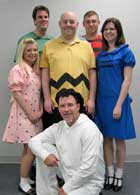 But a show doesn’t have to be epic, like “Aida,” to tattoo itself on your heart. Take, for instance, the Beaufort Theatre Company’s recent production of “You’re a Good Man, Charlie Brown.” This was a little show with a great big soul. Six actors, spare set pieces in primary colors, good songs sung well, and a heaping helping of wry, poignant Schulzian humor. Simple recipe, delicious results. Unlike at the Arts Center, where most of the actors are professionals brought in from out of town, the BTC is all about local talent. And boy, have we got it! Benji Morgan (a music teacher at Red Cedar Elementary) could not have been more endearing as everybody’s favorite blockhead. And Kristin Brady channeled “Lucy” with dizzy, dazzling aplomb. (She happens to be my daughter’s music teacher at Lady’s Island El. What fun it was to see her shine in this role!) The rest of the cast members (Jordan Culver, Kasey Hummel, Michael Kirby and Darryl Poovey) were marvelous, too. When they all gathered to sing the finale – the sweet, wistful “Happiness” – I wasn’t quite sure why I was so weepy. Maybe because I didn’t want the show to end. Maybe because, for two hours, these six actors had taken me out of myself and into their quirky, beautiful world – and allowed me see through new eyes – and I was grateful.
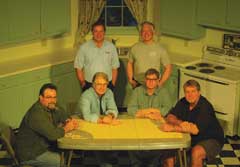 “True West” at WJWJ was a whole different animal. Dark, menacing and surprisingly hilarious, Sam Shepherd’s black comedy was like “Charlie Brown” on crack. And without the show tunes. My husband Jeff played Austin, the “successful” screenwriter, and Tom Schuster was his brother, Lee, a petty thief, drunkard and longtime loser. Rounding out the cast were Leo Gannon as Saul, the Hollywood agent, and Mary Strick as Mom. Only a little over an hour long, the show moved like a train, propelled from one quick scene to the next by great writing and self-assured performances. (Jeff, Tom and Leo all have decades of experience, while Mary made an impressive theatrical debut as Elaine in last fall’s BTC production of “Arsenic and Old Lace.”) When it was over – quite abruptly – you felt like you had really been through something. I’m still trying to figure out what, exactly. It’s a play that asks more questions than it answers. And it keeps asking them, long after you leave the building. If “Aida” and “Charlie Brown” left me stirred, “True West” left me shaken. As far as I’m concerned, it’s all good.
 To hell with pineapples and stars. Palmettos are the newest status symbol in the gradually greening tourism economy of the Lowcountry.
Site Designed and Maintained by Vision Technology Management
Follow us on Social Media:
|
Home
Opinion
Opinion
|
|
||||||||||||||||||||||||||||||||||||||||||||||||||||||