On the spring’s full moon this May 6, scientists, Master Naturalists and members of the Department of Natural Resources (DNR) will be gathering in great anticipation for the arrival of two endangered species on South Carolina’s barrier islands. “To me this has always been one of nature’s greatest stories,” said Pete Richards, President of Fripp Audubon. That is, the story of the horseshoe crab and a shorebird called the Red Knot, and the synchronicity of their fragile existence.
April 22 is “Earth Day.” So, is it a day to celebrate the outdoors in the Lowcountry, to feel the splash of a saltwater mist and breathe in the fresh air? Or, is it a day to raise awareness of the planet’s “cancer” – the metastasized tumor, if you will, that is slowly degrading air and water quality, piling toxic waste, expending energy and destroying the ecosystems we cherish? Perhaps this Earth Day we’ll ask ourselves: Am I sensitive or am I proactive?
What’s the difference between sports like football – currently on everybody’s mind – and kayaking? Kayaking is an expedition. Kayaking is not just some upper body workout; it’s about tackling the elements and making a pass at a little more adventure in your average day. It’s unbelievable that it took some marine dropping a cheesy pickup line on me to finally get me out at Hunting Island State Park in a kayak. He’d asked about some good places to go hiking in the area and naturally I recommended Hunting Island.
“You wanna take me on a personal tour?” Oh, brother.
But I did. I put him in a touring Tsunami and myself in a 14-foot recreational Wilderness System, the Pungo 140. Touring kayaks are longer and narrower than recreational kayaks. Their more streamlined width usually makes it easier to accelerate and maintain speed. On the other hand, recreational kayaks are more maneuverable, and I figured I could hold my own against the first-timer marine.
It happened to be a gorgeous day. Fortunately, here in Beaufort great sun-shiny weather is abundant even in January. But, don’t let a little weather scare you off. The rocky ocean or a thick fog can be just as much fun.
As a rookie, I’d have to say that the Hunting Island laguna will spoil any recreational or day touring kayaker. The South Carolinian jungle (as I see it) on either side cuts the ocean wind, protecting the water and creating calm, placid conditions. Like glass, the water is flat, crystal clear and green, reflecting the light-colored vegetation that shoulders the shore, and I carve through it with ease.
The kayak adventure is like the third-party buddy who fills in all the lulls on a blind date. As we’re traveling the belly of the state park, the exclusive shoreline brings the two of us strangers back to zero, back in touch with core reality. With no other person or manmade thing in sight, the kayak becomes our element, displacing us over the center of this gorgeous body of water. How could you not feel like you are now on an expedition, when prehistoric-like cranes swoop over the water at your line of vision?
Hunting Island is among six barrier islands in Beaufort County that are known as Important Bird Areas, because together they are home to 182 bird species, including several endangered ones like wood storks, bald eagles, Wilson’s plovers, piping plovers, little blue herons, glossy ibises, American oystercatchers, black skimmers, gull-billed terns and painted buntings.
While sightseeing was what I loved the first time I went kayaking on the laguna, I found the silence and isolation of the fog the following week to be mystical. A thick fog had descended upon the island cloaking all visibility, but I’d already made plans according to the tides to get out there. I might have been the only human being out on the water that morning at 8:30 a.m. (aside from the two folks fishing by the parking lot). Even so I disappeared into the thick of it on my kayak.
Out there you are the only ripple, each drip of water from the ends of your paddle send a circular transmission across the surface. You hear a hundred-plus birdcalls; but all you can see are silhouettes cutting through the moist air or bright white herons perched on trees that stick out like stars in the night.
Long story short—I can’t believe it’s taken me so long to discover kayaking in our Lowcountry! What trouble it may seem to folks to strap a kayak on the car and go is illusory. Kayak rentals from Higher Ground are $50 for 24 hours (half-day $30, week $135, and just $10 more for a tandem, a.k.a. two-person kayak), and the friendly staff will strap down the kayak for you. Ask them for recommendations on where to go kayaking in the area, or about currents and shoreline conditions if you already have a spot in mind. Also, word on the street is that Higher Ground will soon have hourly kayak and standup paddle board rentals when the new Factory Creek park opens up. So whether you’re in need of a little more adventure or a little peace and quite in your life, take advantage of where you live and go kayaking!
I breathe in the salt air and think, I know what it is like to grow up without the tides. It is like growing up without the change of colors in the trees during autumn. I came to the Lowcountry in tears, grateful and insecure, leaving behind what I knew and cherished forever. Or at least so it felt. I was moving back in with my parents after college.
I can’t help but compare this strange transition to a second childhood, the difference being that I am not a little girl anymore; I am twenty-three and ripe. I feel like fallen fruit—broken off but still living on their grounds—only I don’t live in Charlotte anymore. This time “home” is in Beaufort, South Carolina.
The backyard is different in my second childhood. The porch is now a sandy floor covered with tree roots rather than the terracotta tiles that my father and mother laid. The shade comes from a sparse forest draped with lacey Spanish moss rather than patches of sour Concord grapes that once hung above us.
The grass is much taller in my second childhood; I am too. Just like hair in the sunlight, the marsh grass is multi-colored and shines from the light reflecting off the brackish water. No-see-ums have taken the place of carpenter bees and wasps; and a dead shriveled tree reaches out toward the water instead of the giant cherry blossom. Strangest of all, there is this river instead of the forest. Each day it seems to take two long breaths in and out. If only I could breathe as slowly and live each hour in awe of the present moment.
I still wonder like a child, only now it’s about my future. I look outside to ask the questions I don’t understand, the questions I want answered. I look unto the Lowcountry. I do not judge it or know how I am to think of it. It’s natural to simply see and listen and absorb.
It’s funny how the outdoors can both silence me and feel like a conversation. I am listening to it, taking it all in, admiring it, thinking a thousand different thoughts or none at all. The nature listens back, takes me in, admires me, reverberates everything and nothing at once. We go back and forth. We don’t have to say a word. Only I am left here lying on the boardwalk with my consciousness that challenges how the nature makes me feel.
As the Lowcountry changes with the winter season, so does my backyard. I don’t see the fiddler crabs anymore on my porch. I don’t see the family of dolphins every day, can’t seem to catch shrimp either. Winter tends to be a time of hibernation from the outdoors, but not for everyone.
My best friend from childhood actually moved to Beaufort too, making him also my second childhood best friend. However, this time he’s sort of homeless.
“Where are you?” I ask him on the phone. It’s night and raining and the cops are everywhere.
“I’m here,” he says. I pull up behind him in the parking lot into a giant puddle. I step out of my mother’s BMW and quickly jump into his car.
“Let me move my furniture,” he jokes, moving his leather bags. “Like my walk-in closet?” He motions his head to the backseat. “It’s my bed too.”
“Check out the pad,” I joke back. Somehow we can be light-hearted and laugh about his first night sleeping in his car (besides that one night at Bonnaroo). I blame it on our youth.
Living outside for the sake of a dream as opposed to destitution—as in his case and that of many other young Americans—showcases youth’s resilience. I suppose we know best how to dance on the knife’s edge, between letting adversity swallow our spirit and letting confidence pull us up by the collar. Maybe my friend, maybe I feel defeated and hopeless, but it’s that idealism that picks us up and dusts off the shoulder.
My friend would tell you he’s “classy homeless”; and if you saw his haut fashion sense or heard him speak of current events, you couldn’t imagine upon a more perfect paradox. But how would you judge someone who’s found a home outside during the winter? So far I’ve found that the Lowcountry’s beautiful frontier accepts us all. This winter I’d like to explore life outside.
The Outsider goes on a photography excursion with Eric Horan
“I think when you talk about nature and wildlife photography, just by the title of it, you’re in two schools: the school of the natural world and the school of the box.” This is coming from Eric Horan, well-known local wildlife photographer. We’re driving to a boat landing that’s just before the Harbor Island Bridge, just after golden hour.


 On the spring’s full moon this May 6, scientists, Master Naturalists and members of the Department of Natural Resources (DNR) will be gathering in great anticipation for the arrival of two endangered species on South Carolina’s barrier islands. “To me this has always been one of nature’s greatest stories,” said Pete Richards, President of Fripp Audubon. That is, the story of the horseshoe crab and a shorebird called the Red Knot, and the synchronicity of their fragile existence.
 April 22 is “Earth Day.” So, is it a day to celebrate the outdoors in the Lowcountry, to feel the splash of a saltwater mist and breathe in the fresh air? Or, is it a day to raise awareness of the planet’s “cancer” – the metastasized tumor, if you will, that is slowly degrading air and water quality, piling toxic waste, expending energy and destroying the ecosystems we cherish? Perhaps this Earth Day we’ll ask ourselves: Am I sensitive or am I proactive?
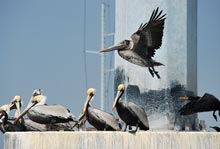 “I think when you talk about nature and wildlife