
| Port Royal: "No faurer or fytter place" |
|
| Written by Wendy Nilsen Pollitzer |
| Tuesday, 08 November 2011 12:17 |
|
Excerpts from the book Images of America: Port Royal, by Wendy Nilsen Pollitzer
This article is the first in a two part series. To understand Port Royal’s many circumstances of untimely fate, this first article will explain the history of the town to include information about the area’s wealth of forts, the Port Royal Railroad, the phosphate industry, the Port Royal Navy Yard and US Marine Corps, the shrimping industry and finally, the Port of Port Royal. In the next issue, the second article will introduce the Town of Port Royal as it exists today… what’s scheduled to ensue with the sale of the port property, how the Cypress Wetlands project and the Port Royal Sound Foundation will enhance quality of life and what the town is doing to create opportunity for economic success.
The Town of Port Royal was incorporated in 1874; the history of the Port Royal area, however, dates back to 1562, when Capt. Jean Ribaut, a French Huguenot, led an expedition with two vessels from Havre De Grâce, France, to prey on Spanish treasure fleets returning to Spain from Central and South America. Ribaut discovered a large harbor with marshes, rivers and inlets surrounding its entrance. He named the area Port Royal, the settlement Charlesfort, and the region Carolus in honor of King Charles IX of France. Ribaut wrote that he had found, “…no faurer or fytter place…than Port Royal.” He returned to France and left several men behind to defend the fort, but after several months, the men mutinied and sailed back to Europe. The Spanish destroyed Charlesfort to erase any claim the French had on the land and eventually established a permanent settlement in St. Augustine, FL. The Orista and Escamacu Indians, inhabitants before Ribaut’s discovery, were once again the area’s only dwellers. But, in 1669, the English settled the region, colonized present-day Beaufort, and later relocated to Albermarle Point in Charleston, where it was deemed safer by explorer Henry Woodward.
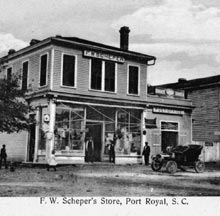
Port Royal Railroad Company ultimately chose acreage surrounding the Old Fort Plantation for the site of its terminus. In 1869, Stephen Caldwell Millett began construction on the railroad that spanned all of Port Royal Island, from the Coosaw River to the Battery River. It was completed in 1874, the same year a charter was issued for the Town of Port Royal. The town was laid out with wide streets, 25x100-foot lots and 200x500-foot blocks, with commercial and industrial development in mind. Port Royal grew quickly, boasting a cotton compress, reputed to be the largest in the world, numerous train elevators and warehouses, and a thriving port. Merchants took advantage of the natural depth and width of the Port Royal Harbor, In 1876, a coaling station and naval storehouse at neighboring Parris Island was set up followed by the construction of the largest wooden dry dock on the East Coast. The U.S. Naval Station at Port Royal welcomed great battleships. In fact, the USS Maine was stocked with provisions from the Scheper Store in Port Royal before departing for Cuba on what became its final voyage. The loss of the battleship in the harbor at Havana triggered the Spanish-American War. During the 1800s, many homes were built by prospering merchants. The town enjoyed mercantile establishments, grocery stores, drug stores, a hotel, a bakery, a blacksmith and 17 bars. The town even supported its own newspaper, the Palmetto Post. In 1882, S.H. Rodgers, editor and publisher of the newspaper wrote, “Recognizing the Town of Port Royal as the great seaport of the State, we believe that in fostering and encouraging its commercial interests, we will thereby advance the material wealth of South Carolina and add to the happiness of the people of this section.”
Small industry saved the town from total economic and social demise. In 1922, Capt. Charles Vecchio brought commercial shrimping to Port Royal. In October 1997, the Town of Port Royal adopted the Traditional Town Overlay District. It put restrictions on material, size, and placement of new structures on Paris Avenue and other streets in the heart of town. Though it upset many residents, the ordinance was intended to control growth, create pedestrian-friendly streets, encourage newcomers, and generally beautify the town, and that it did. Real Estate speculation soared in the late 90’s and early 2000’s. In fact, dirt in Port Royal was the most expensive in the county. But, in 2008, when the recession began, prices plummeted and Port Royal once again experienced economic decline.
Today, Port Royal is in the midst of making significant history. In 2004, Gov. Mark Sanford signed legislation to sell the Port of Port Royal, owned by the State. The valuable waterfront acreage is scheduled to be sold to developers this month, which will put the property back on the town’s tax rolls. An announcement of the intent for use of the Lemon Island Marina will be November 19th, and completion of the Cypress Wetland beautification project will be early December. Martha Ann Moussatos once wrote, “I dream of her sleeping harbor someday awakening and making the little village stand tall and distinguished once more. Until then, Port Royal remains small, quiet, retrospective, and still good to call home.” I believe that many share Ms. Moussatos’ sentiments. And the Town of Port Royal may soon be able to exhale and enjoy a break. They’ve certainly worked hard for one.
|
 The Town of Port Royal is in the midst of making
  significant history… again. The incorporated town has seen its ups and downs for over a century; and now, Port Royal is on the brink of prosperity. Many believe the current slate of events will the propeller that finally puts the quaint coastal village on the map. With the sale of the port property, the completion of the Cypress Wetlands project and surprises planned for The Shed and Lemon Island Marina, the Town of Port Royal is prepared to stand tall and distinguished once more.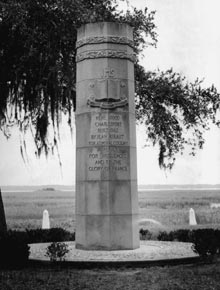
 In 1727, the British built a fort they named Fort Frederick to protect South Carolina against French, Indian, and Spanish threats. By 1758, Fort Lyttleton was built at Spanish Point and Fort Frederick abandoned. Fort Frederick and the surrounding land was absorbed into Old Fort Plantation, owned by John Joyner Smith. When Union troops captured Beaufort and Port Royal during the Civil War, Smith’s Plantation became headquarters to the first regiment of freed slaves recruited for Federal service. The site was renamed Camp Saxton. After the Civil War, the land was sold at a direct tax sale to the United States government. The Port Royal Railroad Company petitioned the state of South Carolina to construct a railroad from Augusta, GA to Port Royal Island, South Carolina, and also build a city at its terminus. Investors began speculating land to become the City of Port Royal. Hilton Head, though naturally located for a commercial port, was too exposed to storms, according to railroad experts. The editor of the New South newspaper described Land’s End on St. Helena as the “only proper site for a New City of the South.” As late as 1867, Land’s End was expected to be the terminal of the railroad.
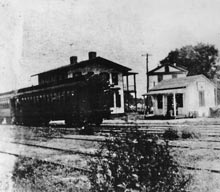 which could accommodate the largest ships in the world. In fact, the entire U.S. Fleet assembled in Port Royal Harbor in 1874. Vessels loaded coal, phosphate and lumber brought in by rail. The Phosphate industry in the Port Royal area alone employed 2,500-3,000 people and shipped out more than Charleston and Savannah combined. Port Royal’s economy was booming!
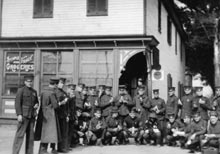 In August 1893, a great hurricane struck the area. Railroad tracks were washed out and much of the machinery of the phosphate industry was destroyed. The catastrophe was followed by political conflict of Upstate and Lowcountry interests. Gov. “Pitchfork” Ben Tillman raised the state tax on each ton of phosphate from $1 to $2. Subsequently, merchants obtained phosphate in Florida at a cheaper price. The two phosphate mines in Port Royal-Baldwin and Wilson-eventually closed. Another calamity occurred when a visiting schooner brought in a deadly yellow fever epidemic, causing a large loss of life. It is believed that the dead on board were buried somewhere on the banks of the wharf, presumably at the end of 14th Street, beyond the railroad tracks. As a final blow, the Secretary of the Navy ordered that the Port Royal Navy Yard be moved to Charleston in 1902. Business with the Port Royal Railroad began to decline as railroad interests moved to Augusta. The cotton compress and the train elevators were removed; discriminatory tariff rates diverted railroad business to Charleston and Savannah; and the advent of the automobile and trucking took away much of what was left of the railroad business in Port Royal. In an article written by Martha Ann Tyree Moussatos in Sandlapper magazine, she described the final blow, “This, with all that preceded it, finally brought the little boomtown with the great and historic harbor to her knees, and she has never risen to her full height since.”
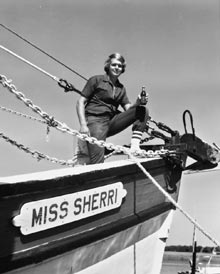 Local entrepreneurs invested in boats, and large scale shrimping soon followed. In 1937, Blue Channel Corporation, packers of Atlantic Seafood, moved into town, providing good jobs and opportunity to the area. The Parris Island Marine Corps Recruit Depot expanded during WWII, also providing civilian jobs to residents of Port Royal and a small, but stable economy for the town. And, in 1958, the Port of Port Royal was dedicated, which created hope that Port Royal would once again enjoy great wealth.