| Start to Finish |
|
| The Outsider |
|
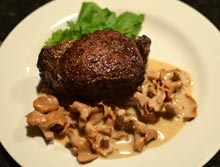
If you see a brunette man with a woven basket foraging your wooded property for wild, vibrantly colored mushrooms, please don’t be alarmed. It’s probably my father, or Mr. Mali as many parents and schoolchildren know him. While many Americans are quick to judge the seemingly crazy Frenchman hunting for mushrooms in their yard, I see my dad harvesting fresh, locally grown chanterelle mushrooms that he will later prepare in a white wine cream reduction over chateaubriand steak for dinner.
My father’s French culture has made for an interesting upbringing as a child in the States, to say the “Deux fourchettes, deux fourchettes!” I’d cry out to my dad in excitement whenever I found a chanterelle, a golden-orange mushroom with gills under its flat hat. In his mushroom guidebook the “deux fourchettes” or “two forks” symbol signified a delicious mushroom to eat. Some of the mushrooms in the book would be marked with a black skeleton, which meant they were poisonous; others had a red “x” meaning that the mushroom was tasteless or poor tasting. Chanterelles, on the other hand, are easily identifiable and actually considered one of the “foolproof four” (the other three being chicken mushrooms, giant puffballs and morels). As a child I never questioned what my father put on the table for dinner—not just because he was my dad, but because he became an exquisite chef after going to culinary school in Geneva, Switzerland.
We pull over, sometimes in front of someone’s house, to harvest. If we’ve found a goldmine, my dad will go knock on the front door of the house to introduce himself. He’ll explain that he’s a French chef (as though it’s some sort of excuse) and that there are excellent mushrooms growing in the yard that he’d like to pick up. Most people wave him on incredulously. Others act interested but then refuse the “They’re everywhere!” Papa exclaims in French as his eyes light up like a kid on an Easter egg hunt. Bent over, we cut the stem of the bright orange mushroom for two reasons: to preserve the mycelium in the humus through which fungi absorb nutrients from the environment; and to leave the dirt. Mushrooms shouldn’t be washed because of their porous nature; they absorb water like a sponge, depleting the flavor and nutrients and changing the texture. Instead we brush the dirt off the mushrooms or wipe them with a damp cloth. “It pays off in your plate,” my father would say.
Prized for their wonderful apricot fragrance, Chanterelles are among the most flavorful mushrooms sought-after by chefs, and therefore command a high price at restaurants and specialty shops. They’ve been a widespread culinary delicacy since the 1700s when the French began cooking them in palace kitchens for the nobility. And aside from their culinary merit, wild mushrooms provide the best non-animal source of vitamin D. They’re also low in calories, fat-free, cholesterol-free, very low in sodium, and yet loaded with important antioxidants and vitamins like selenium, potassium, riboflavin and niacin. Honestly though, I forage wild mushrooms more for my dad than the apricot fragrance of a chanterelle. To explore the woods with him and smell the wet earth in the thick summer air. To learn from him about edible mushrooms or the paralysis of American paranoia. To hear him say things like, “I miss doing this stuff with you girls. Isn’t that why you have kids in the first place? To do stuff with them, to live, be, teach, learn, share with them.”
|
 The Outsider and her dad go foraging for wild mushrooms... then cook them and serve them over chateaubriand. ("Papa" happens to be a French chef!)
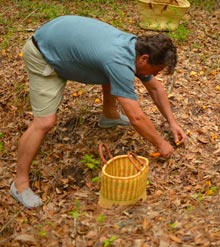 least. When I was a little girl my dad would take my sister and me to the public park to search for mushrooms. Forget throwing a football. We wandered from park trails browsing the forested floor. Uncovering the humus that cakes the earth, we discovered hidden varieties of mushrooms.
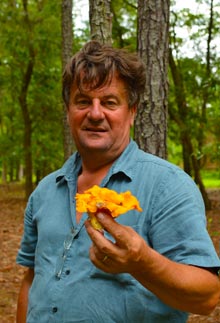 Today, as a young woman, I still like to pick wild mushrooms with my father—only now we prelude the trip with a glass or two of Côtes du Rhône. After any heavy rainfall on a summer’s night, we grab a basket and knife and hop into his old truck in anticipation of newly sprung shrooms. My dad spots the chanterelles freckling the earthen tapestry like a sailor at sea spots land off in the distance.
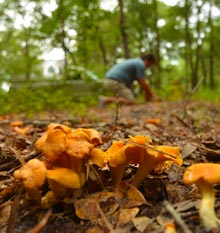 chanterelles.
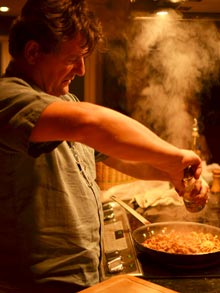 Tonight Papa sautés the cleaned, locally harvested chanterelles in olive oil with garden fresh parsley, salt, pepper and garlic. In an effort to bring out the flavor in anything he cooks, he never overwhelms the main dish with loads of ingredients. He adds some cheap white wine (never the good stuff) and reduces it, repeating with heavy cream for a delicious sauce. He’s seared the chateaubriand, the thickest cut of the steak tenderloin, in a cast-iron skillet and puts it in the oven for 10 minutes. He teaches me to let the meat sit for another 10 minutes after it’s cooked to absorb the blood—this is what makes a piece of meat juicy.