
| Nature and The Box |
|
| The Outsider |
|
The Outsider goes on a photography excursion with Eric Horan
“Whatever it is you’re after, you have to know something about that animal to get the pictures,” he continues. “You have to know its habits, when they’re doing what, where. You have to figure out an approach, how’re you’re going to get there, whether it’s on a boat or car or kayak.” Eric’s approach as a photographer is his boat. Today he’s allowed me to tag along as he tak We go out easy into the tributaries of the Harbor River trying to catch the wildlife of the marsh in the morning fog. Trying to take a picture of a bird in flight through the viewfinder of my telephoto zoom lens is like playing darts with my eyes closed—a shot in the dark. I guess I have a lot more to learn about “the box.” “The box,” Eric continues, “is this camera with dials and buttons and gizbang this and that. You’ve got to figure out how to put that world with the other world, because when you’re faced with wildlife in nature you better have the box together or you’re not going to get your picture.” And yet with Eric as nature guide, photography coach and bird encyclopedia, I manage. The outing becomes thrilling and opens up a new world just as he said. Whenever the boat slows down, I get excited. The old couple and I know Eric’s about to point out something we failed to see. What is it? He puts a bug in my ear, “Get ready,” he says. I bring my camera up to my eye. “They’re going to fly out from over there,” and motions to the Spartina grass ahead to the left. Two cormorants, black and slick, bullet out of the grass over the water and Eric accelerates the boat so that we can keep up with the flight of the birds for a great shot.
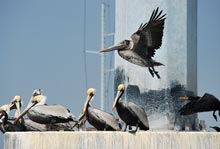
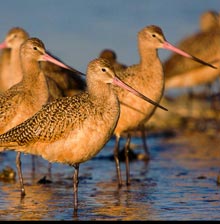
We cruise by a mob of brown pelicans that are hanging out under the bridge as we round Harbor Island on St. Helena sound moving towards the Atlantic. From the water we can see an area closed off to people with signs for the protection of nesting shorebirds like Wilson’s Plovers; and, on the other side of the boat is a small island born by low tide and peppered with shorebirds. Eric names them all but I hold on to the Marbled Godwit, a cinnamon colored shorebird that I’ve never seen before. We see a team from the Department of Natural Resources (DNR) out on the beach with massive spotting scopes. Eric waves them down to say hello. They’re observing a flock of Red Knots amidst a mélange of other birds. It’s inspiring to see so many different birds getting along together. Red Knots, Eric informs us, have dwindled in numbers in part because of the commercial fishing of horseshoe crabs. Here in our locale the birds stop on their migration path from the Artic to South America to feed on hard-shelled mollusks and horseshoe crab eggs. On our boat ride back, Eric stops the boat again. This time he’s spotted a Bald Eagle perched far in the distance on a naked tree, impossible to see with the untrained eye. Out of nowhere, he pulls out his camera that’s been hiding under my seat with its 500mm telephoto lens longer than my forearm. “When you spend so much time out there trying to see wildlife you get good at it,” he explains. This photography outing revealed a new world of birding in the Lowcountry that I’d never appreciated before and also insight into the challenges of wildlife photography. Anyone with a decent telephoto lens should take advantage of learning from this Master Naturalist and professional photographer who is as kind and informative as can be. It’s like taking a boat tour with a Native American; only he knows where the wild things are. He is also leading wildlife photo adventures with Marvin Bouknight. Visit Eric Horan’s website at www.horanphoto.com. |
 “I think when you talk about nature and wildlife
 photography, just by the title of it, you’re in two schools: the school of the natural world and the school of the box.” This is coming from Eric Horan, well-known local wildlife photographer. We’re driving to a boat landing that’s just before the Harbor Island Bridge, just after golden hour.
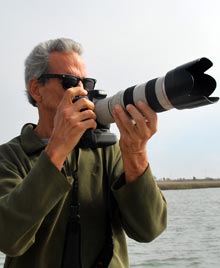 es out a couple on one of his wildlife tours. Ever since the economy crashed in 2009, he’s been taking people out, namely other photographers, on marine photo adventures. “I do whatever we have to do to get good pictures for everybody. The close contact is thrilling. Opens up another part of the world,” says Eric.
 Eric’s career as a nature photographer began as a boy on a hunting excursion with his brothers out West. “The first time I killed a bull elk I said, ‘pshh that’s no fun.’ So I quite that, and that’s when I picked up a camera.” His first job right out of college as a photographer was for the Colorado Fish and Wildlife Conservation Department, where he’d fly around in helicopters and camp for two weeks at a time photographing elk and big horned sheep on someone else’s expense account. After a long career as a freelance commercial photographer in New York, Eric moved back down to Beaufort to “begin” his career in photography.