
| Creating a Biblical Garden |
|
| How Does Your Garden Grow? |
|
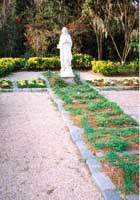
My mother was a Sunday school teacher all the years I was growing up, and she also was an avid gardener. Each Saturday she liked to sit in her garden and prepare her lesson for the next day. Whenever she came across a plant in the Bible, she would make a note of it, and often, later that afternoon, we would go in search of it at our local nursery. Over time, she created what they now call a 'biblical garden,' although she called it her meditation garden. She added a St. Frances of Assisi statue and a birdbath and feeder and it was quite a lovely, peaceful, and song-filled place. Today, there are two types of biblical gardens, Old Testament ones and New Testament ones; actually, some gardens combine them both. Many synagogues in America have built Old Testament gardens, one in particular starts with a fountain representing the River Jordan, that flows into a long formal pool lined with bull rushes and papyrus New Testament gardens would, of course, also feature grape vines, and could also have the little flower 'Star of Bethlehem'; they might even feature the small desert trees frankincense and myrrh, whose resin was the gift of the Magi, although they are very hard plants to find in the U.S. and germinate. Barley would be good to plant, as I'm sure you remember that Jesus 'took barley loaves and fish from a small boy, and fed a huge multitude with them.' (John. 6:9). And black mustard would be good, too, considering Jesus’ words that 'Faith, even if it is small like a mustard seed, can grow into something substantial when given to God with an open heart' (Matthew 4:30-32). So these, along with the 'palm' tree which welcomed Jesus into Jerusalem, would be good for a New Testament garden. Other plants to consider would be the 'centaurea' plants, which are related to the thorns that were All in all there are over 114 plants mentioned in the Bible that help illustrate the stories and people connected with them. The book 'Sources and Resources for Biblical Gardens' by Rev. Marsh Hudson-Knapp lists them all, along with two excellent books on the subject by Dr. Musselman: Figs, Dates, Laurel, and Myrrh: Plants of the Bible and Quran along with Jordan in Bloom.
If you want to learn more about this fascinating way to make history come alive, a good place to start would be the Biblical Botanical Gardens Society's website for lots of interesting photos and links. www.bbgsusa.com And if you would like to visit one, Magnolia Plantation, in our own backyard has one of the finest Biblical gardens in the South East. |
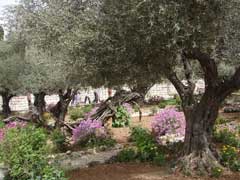
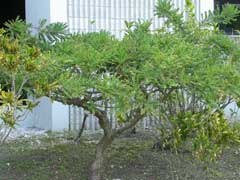 plants. Then you can sit under olive trees and walk under a grape arbor, then through a grove of fig trees – fig being the first plant mentioned in the Bible. (Remember those leaves used by Adam and Eve to cover themselves?) The Bible path also features almond, pistachio, & carob trees, which allow visitors to smell, touch, and taste the plants from the Bible. The central feature of the garden is a Cedar of Lebanon. Cedar was used to line the Temple of Solomon and build the Ark of the Covenant, so cedar trees are a good choice for a Biblical garden, and they’re often seen planted in cemeteries for the same reason. The pomegranate was a symbol embroidered on the robes of Hebrew priests, so pomegranates are often planted along with wheat as a symbol of 'fruitfulness'. For the Feast of Passover, the plants endive, chicory, dandelion, and rocket may have
 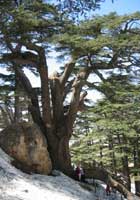 been the bitter herbs of the Exodus (Ex. 12.8). The miraculous mann from heaven is believed by some to come from the honey-like crystals that form on the tamarisk tree. In his book 'Torah and Flora', Louis Rabinowitz identifies the burning bush of Moses as Rubus Sanctus, a flowering bush with thorns related to the rose family. He also says acacia was the wood used to build the ark and that Noah planted the first vineyard.
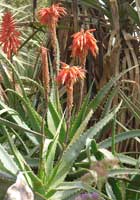
 made into a crown for the crucifixion, and 'hyssop,' that was given to Jesus on the cross. After death, 'aloe' was used to anoint his body. 'Poppies' like those in Israel that grow outside the Garden Tomb are often planted in America around recreations of the tomb with the stone rolled aside. Roses are mentioned in the New Testament, and the red rose in particular has historically been used in gardens to symbolize Jesus, with the white thornless varieties like 'Iceberg' used to symbolize the Virgin Mary. Often these two are planted together.
 There is some debate over which plants in the Bible are the same as their modern day counterparts. For example, the horticultural experts say that the cross could not have been made from the Dogwood tree, as it does not grow in that part of the world. (But my mother planted one for it's lovely symbolism, just the same). Interestingly, there was a recent study of all the wood fragments exhibited in churches across Europe and the far east that claim to be from the cross, and they all turned out to be from the Aleppo pine which does grow in Israel. Also, Eve probably did not eat an apple, as an apple tree is not mentioned in the Bible, nor are they native to the Middle East. Scholars believe it was an apricot.