Our series destined to rewrite your children's history book.
Where America REALLY Began Pt. 8
Written by Daryl Ferguson
Tuesday, 11 February 2014 14:14
Part 8: Spain Enter Port Royal Sound
You and I have been taught that America started with the English landing at Jamestown, Virginia in 1607. We have also been taught that the next major European settlement was Plymouth Rock, settled in 1620, also by the English. But the facts say otherwise. Last December I shared with you how France's top admiral, Admiral Gaspar Coligny, talked his king, Charles IX, into planting the French flag in Spain's La Florida. Admiral Coligny was a Huguenot, a French protestant. King Charles was a Catholic. And France was in religious turmoil. Admiral Coligny's hope was that they would make La Florida a refuge for the Huguenots. In 1562 Admiral Coligny's best sea captain, Jean Ribault, set sail with two ships, and 150 men, for Spain's La Florida.
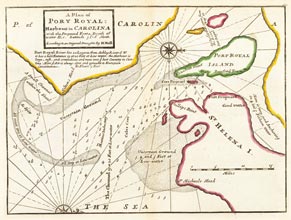
France just made a big tactical mistake. In 1562 it chose to establish a settlement in America on Parris Island. It really was not Parris Island that they wanted. They wanted a settlement next to Port Royal Sound. Port Royal Sound, of course, was the widest and deepest harbor on La Florida's Atlantic Coast. And Port Royal Sound was at the "hinge" where the Spanish gold fleet had to turn east to return to Spain. If you wanted a settlement at a point where it could pick off the Spanish gold fleet, you would settle at Port Royal Sound.
Spain was near bankruptcy. However, King Philip had to find a way to finance a multi-year effort to establish a permanent settlement in La Florida. He had a plan. He would ink a "conquest contract" with a strong leader to settle La Florida at the explorer's expense. Under contract that explorer would receive a percent of the resources shipped to Spain and would also receive tax benefits, a huge estate, and the titles that go with running an entire colony. That leader, or Adelantado, as they called them, would have governmental control of La Florida for two lives. King Philip II knew of only one person who could do the job – his main Fleet Commander, Pedro Menendez de Aviles.
Menendez's contract required him to do more than confirm Spain's claim to La Florida. It charged him with creating two or three settlements. He was also asked to find an inland route to Mexico. That would give Spain a safer route to move bullion from Mexico to Spain. Admiral Menendez had much more to do than establish settlements, he had to explore and expand inland. He was also charged with converting all Native Americans in the colony to the Catholic faith. In return he would get a cut of the wealth that would be shipped back to Spain.
Pedro Menendez's first task was to remove the French from La Florida. The French had already abandoned Charlesfort at Parris Island. In 1565 Menendez destroyed the French Fort of Fort Carolina near Jacksonville. To do this he established a military outpost and called it St. Augustine. Once Jean Ribault had landed near St. Augustine, Menendez killed him and destroyed his fleet. Spain's Menendez completed his first assignment . . . to remove France from La Florida. Menendez now had an entire country, or colony, to govern. It ran from the Florida Keys to Newfoundland and from the Atlantic to the Pacific Ocean. To govern this new country he needed a complete settlement that would also be the capital of La Florida. He made the same decision that France made. His choice was Parris Island on Port Royal Sound. His choice was the medieval Spanish town of Santa Elena.
His strategy was this: Put a strong settlement, and fort, on Port Royal Sound. It was a perfect location for Spain. It could protect the very point where the Gold Fleet was vulnerable . . . where the fleet had to follow the Gulf Stream and turn east toward Spain. Santa Elena would become the first major European settlement in America from 1569-1587. It would also be the capital of La Florida from 1571-1576.
THUS, THE FIRST MAJOR EUROPEAN SETTLEMENT IN AMERICA WAS NOT JAMESTOWN, VIRGNIA, PLYMOUTH, MASS. OR ST. AUGUSTINE.IT WAS SANTA ELENA located on Parris Island. Santa Elena was largely a military outpost from 1566 to 1569. It became the first major European settlement in 1569. And it became the first European colonial capital in America in 1571. Dr. Rowland was right. "America really did start here."
As a historical tourism asset, what does this mean to us? It means this: The French settlement of Charlesfort on Parris Island was not a major historical settlement. It lasted only one year. But Charlesfort was important because it triggered Spain to permanently settle North America. Even more important, we now know that America did not start at Jamestown, Virginia. It did not start at Plymouth Rock. It started at Santa Elena, located on Parris Island. Santa Elena, in 1569, was the first major European settlement in America. It was Spain's first colonial capital in America. In Spain's eyes, by 1571, Santa Elena was the capital of La Florida. And La Florida included all the territory that European explorers had identified as "America" at the time. Spain's La Florida ran from Canada to the Keys and from the Atlantic Ocean to the Pacific. Think of this. In Spain's eyes in 1571, Santa Elena was the capital of "America." The only difference is that Spain didn't call it "America." They called it La Florida.
When Jean Ribault landed at Parris Island in 1562, France was ruled by King Charles IX. He was an emotionally weak boy-king who could easily be manipulated. He was only twelve years old. However, his mother, Catherine De'Medici and Admiral Gaspar Coligny were part of the power behind the throne. Oddly, the admiral was a Huguenot . . . and a leader of the French Protestants.
Dr. Rowland made a rather extreme statement. He said, "America started here –not in Jamestown, Plymouth Rock, or St. Augustine." If America really began "here," we will have certainly identified a gigantic asset for not just South Carolina . . . but for our country. But can we prove that America began here . . . in Beaufort County? In South Carolina? I believe the answer is "yes." You and I first formed our ideas about where America began in the classroom. Later on we were influenced by the promotional material that was distributed by Jamestown, Plymouth, MA and St. Augustine's Chamber of Commerce. I took the time to review several of the American history textbooks that our 7th and 8th grade students read. To generalize, this is what they say: "The Spanish were the first to send a number of explorers to America. They failed at trying to establish settlements. The first major settlement was an English settlement at Jamestown in 1607. The second major settlement was at Plymouth, MA, in 1620. That is where the Pilgrims landed. The Spanish did establish a secondary settlement at St. Augustine. It is the nation's oldest continuously existing city."
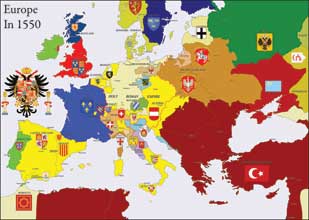
This may sound correct. But it is not. When I started to dig into this issue, Larry Rowland suggested that I first understand the economic and political situation that the three major European powers were in at the time. He said with firmness in his voice, "When you understand how France, Spain, and England were relating to each other in Europe, you will then understand how they entered America." It made sense. So I went back to school. This is what I learned. This was Europe around the mid-1500. When Spain's King Charles V died he left his son, Philip II, with an empire that included Spain, the Spanish Netherlands, Naples and the American colonies. Spain's economy, however, was based on conquering territory and extracting valuable assets . . . like gold from Peru and silver from Mexico. Spain was not a trading country. It relied on the Dutch in their Netherland's "colony" to do their trading. One would think that with the 339,000 pounds of gold that Spain had extracted from Central American mines that Spain would be wealthy. It wasn't. It was on the edge of bankruptcy. Spain was spending more than it took in. While it was extracting gold and silver in Central America, it was plagued with a protestant rebellion in the Netherlands and a war with the Turks in Italy. Meanwhile, English and French privateers (i.e. commerce raiders) were attacking its ships in the Caribbean. Spain also saw itself as the standard bearer for Catholicism. And, as the Spanish Inquisition showed, it was willing to use a firm hand against any country that gave any support to Protestants.
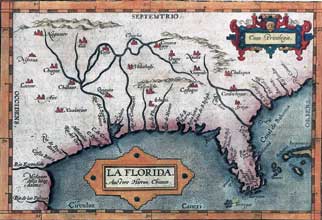
Spain believed that it had a good reason to be the world zealot for Catholicism. In 1494, the Spanish Pope, Alexander VI, issued a degree which gave all unclaimed world lands to either Portugal or Spain. The Treaty of Tordesillas split the "New World" between Spain and Portugal. The line of demarcation gave most of North and South America to Spain. Brazil was given to Portugal. In King Phillip's eyes, America was his. King Philip only had one problem. The French and English did not agree.

La Florida stretched from the Keys to France's Newfoundland. And it stretched from the Atlantic to the Mississippi River. Remember, in 1492 no one knew what land existed west of the Mississippi River. La Florida included half of today's United States. This is an early view of the map.
The only problem was that the other major European countries did not accept the Pope's mandate. Spain also had an emotional tie with the unsettled America. In 1526, Lucas Vasquez de Ayllon, a wealthy Spanish lawyer from the colonial capital of Santo Domingo (now the Dominican Republic), tried to establish a settlement in South Carolina. He called it San Miguel de Gualdape. It failed after a few months. In 1528 Panfilo de Narvaez landed at Tampa Bay with 400 men. It failed. Hernando de Soto landed near Tampa Bay in 1539 with 600 men and ten ships. He wandered for three years through the Southeast. Then, in 1559 Tristan de Luna led 1,500 soldiers and settlers to Pensacola Bay. A storm demolished his fleet. Spain paid a big price for these "probes." In the mind of King Philip II, he already owned America. It was just a matter of when he could afford to mine his claim.
Where America REALLY Began Pt. 5
Written by Daryl Ferguson
Thursday, 21 November 2013 10:23
PART 5: Larry Rowland Defines The Lowcountry
We know that over ten million North Americans take ship cruises each year. What are these tourists looking for? Approximately 43% of all cruise vacationers chose a Caribbean tour. Alaska and the Bahamas each drew 25% of the nation's cruise customers. These tourists chose a ship's cruise for one important reason. They want to visit multiple locations, or destinations, and experience a range of activities.
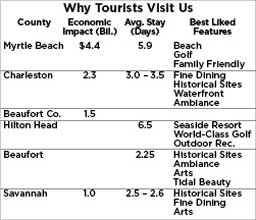
The first question that Stu Rodman and I had to address is this. Do we have enough quality tourism assets to develop a strong fall season? Conceptually, a fall tourism plan that focuses on the entire Charleston to Savannah coast sounds great. But is it? We started by looking at these results. (Fig. 1)
This table tells us a lot about the current strength of our regional market. Myrtle Beach delivers to South Carolina the biggest economic impact . . . over four billion dollars a year. Charleston is next at $2.3 billion. And Beaufort County is third at $1.5 billion a year. The lion's share of Beaufort County tourism revenue comes from Hilton Head tourism.
Notice a couple of points. Both Myrtle Beach and Hilton Head are unique destinations. Myrtle Beach targets the family, and mid-level income tourism market. Hilton Head targets the higher income vacationers who desire beach, water sports, and golf. However, Hilton Head gives this market all the finer accoutrements . . . finer dining and shopping along with a catalog of "other" options. So what does this table show us that could be a basis for building a Charleston to Savannah tourism plan? It tells us this: Myrtle Beach and Hilton Head are unique destinations by themselves. But Charleston, Beaufort, and Savannah all have one thing in common. They draw the same type of customer. It's a tourist who wants to feel the southern ambiance. This customer wants to see our history and sense our Lowcountry aesthetics. This visitor appreciates the arts and enjoys fine dining. The other point that this table seems to show is that Charleston and the town of Beaufort have fairly short tourism stays. Charleston is a world class tourist city. Yet, its marketing to date has only given it an average tourist stay of 3.0-3.5 days. That is not good news for Charleston's hotels. Beaufort suffers from the same problem. It seems to get visitors who only stay for a day or two. Hilton Head is another issue. It attracts a visitor who is willing to stay six days. But it seems to have done little to attract the fall tourist. This begs the questions: What type of tourist attractions would Charleston and Beaufort need to have its tourists stay longer? And what would it take for Hilton Head to have a fall season that's as strong as the summer?
The most important point that surfaces after reviewing this chart is this: We know that tourists go to Charleston, Beaufort, and Savannah for many of the same reasons. So, why don't we promote this entire Lowcountry area? Why don't we encourage these customers to stay longer? Why don't we encourage them to book a week or ten days here rather than a trip to the Caribbean Islands or Mexico's Cozumel?
Stu and I have asked these questions to the tourism directors of Charleston, Beaufort, and Hilton Head. The answer is disappointing. Both Charleston and Hilton Head Chambers follow a destination - directed marketing strategy. In other words, Charleston promotes Charleston. Hilton Head promotes Hilton Head. And Beaufort promotes Beaufort. In a way, it makes no sense.
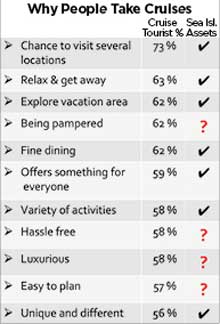
There are many, many people who want to take a week or ten days and visit a number of unique destinations. There is no greater proof then when we look at the ocean cruise industry. Each year it generates 37 billion dollars for the U.S. economy. Over ten million North Americans take these cruises each year. And their cruises average over seven days long. These tourists do not want to travel to just one port. In 2010 The Cruise Industry published this report. It says it all. A huge part of the world's travelers want to travel to a number of "ports." Why? Because they want to go to unique destinations that offer multiple experiences: (See Fig 2, under Cruise Tourist %).
Let's ask ourselves one more question. If the "cruise" customers travel because they want this list of values, what could we offer them if we promoted the Charleston, Hilton Head, Beaufort, and Savannah as one inland cruise? Our answer can be found in Fig 2, in the column under Sea Island Assets.