
| Where America REALLY Began Pt. 2 |
|
| Written by Daryl Ferguson |
| Tuesday, 15 October 2013 09:18 |
|
Part 2: Why Hurricanes Avoid Us
You might be asking yourself, "What do you mean when you say that our risk for fall hurricanes is "relatively low?" That is the term that four hurricane specialists at the National Hurricane Center gave me. It means this: Yes, it is possible for us to receive a direct strike from a hurricane, but the odds are low. For example; of the three major hurricane categories (categories 3,4,and 5), the National Hurricane Center projects that we should be hit by a category 3 hurricane every 79 years.* In other words, the risk is low. To me it was never enough to just hear from a hurricane specialist that our hurricane risk was "relatively low." I had to understand WHY it was considered low. Repeatedly, four different hurricane specialists gave me the answer below. You and I have a few friends and family members who have told us that they do not travel to South Carolina because of our fall hurricane threat. My suggestion is that you mail everyone on your contact list this explanation. "There are real meteorological reasons why hurricanes tend to not hit South Carolina's coast. When a hurricane moves west from the African coast, it can either enter the Gulf or bend north and follow our Atlantic coast. Most of them, however, go into the Gulf because hurricanes usually follow the warmer Gulf water. In late August we are further protected by the Canadian jet stream. At that time the jet stream begins to drop down into the United States. When it does it quickly touches the low pressure trough that is off of our coast. When that happens, it creates a separate weather system that blows 75% of all fall hurricanes out to sea. THIS IS THE MAJOR REASON WHY HURRICANES TEND TO STAY AWAY FROM SOUTH CAROLINA. We also have the advantage of having a concave coast from North Carolina to Jacksonville. Our coast is inset 150 miles from the natural Atlantic coast. Thus, for the infrequent hurricane that gets by, it will usually bend inland and hit the North Carolina coast. That is why our risk for a fall hurricane is considered "relatively low." • Source, National Hurricane Center report of 2010 |
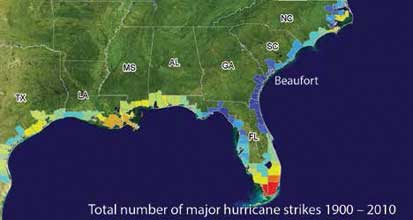 Our tourism plan for coastal South Carolina must focus on the fall . . . for two reasons. First, we now have new information. Our risk for fall hurricanes is "relatively low." Even more important, we know that tourism drops off the map for Beaufort County in the fall. That is especially true for Hilton Head. In short, the fall of the year is our big opportunity. In fact, it is a billion dollar opportunity.