| The Cousteau Effect |
|
| Written by Mark Shaffer |
| Tuesday, 28 June 2016 16:19 |
|
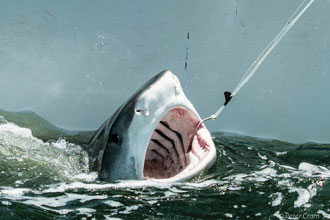
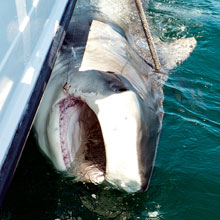
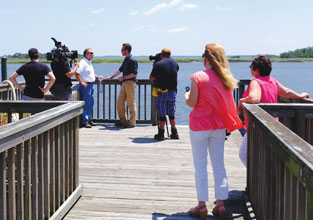
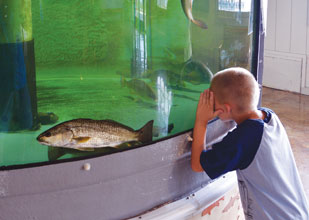
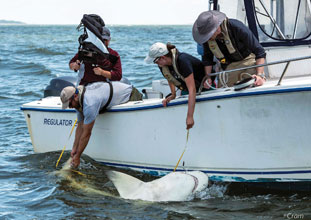
(Shark photos by Peter Cram) The Jaws get you every time. These very, very big jaws hang over the eastern end of the main gallery in the Port Royal Sound Foundation Maritime Center. On the opposite end of the room red drum and sea trout shimmer in the 3,000-gallon display tank on a constant voyage to the Chechessee River just beyond the window. Overhead the sound’s native predators cruise through imaginary waters. The Sound is home to 17 native species of shark including hammerheads and tigers. The PRSF is actively involved with the SC Department of Natural Resources’ ongoing research efforts. “Chessie” (left), a 12 foot long, 1200 pound tiger shark was tagged not far from here in 2015. She is the largest of her species ever tagged on this coast, yet she would be little more than a morsel to the owner of the jaws on the wall. Megalodon (literally “big tooth”) did indeed cruise Port Royal Sound, but not as we know it. A group of young day campers and their chaperones stare up in amazement as PRSF naturalist Chris Kehrer tells the tale of how these 60-foot, 100-ton nightmares swam these waters two million years ago. The tall young man standing by the wall of history listens and smiles. No doubt Philippe Cousteau, Jr. is familiar with the story of Megalodon. But that’s not why he’s smiling. He’s smiling because a room full of kids are spellbound by the The name Cousteau is synonymous with both learning and nature. You might call it the family business. My generation grew up following the adventures of his grandfather Capt. Jacques-Yves Cousteau and crew. We lived vicariously through the voyages of Calypso as she traveled the remote oceans and rivers of the planet, revealing their wonders and mankind’s everpresent threat to them. Philippe’s father, Philippe, Sr., was part of that crew. Sadly, he was killed at the controls of a Cousteau Society seaplane off the coast of Portugal in 1979. Philippe, Jr. was born six months later. Last October Cousteau was the guest of honor for the Port Royal Sound Foundation’s innaugural Night on the Sound. PRSF Director Jody Hayward and Development Director Alicia Taylor were thrilled to debut the annual fundraiser with what is known in certain circles as “the Cousteau Effect.” The event was a massive success and his feet were barely back on the ground in Los Angeles when he contacted Taylor.
“He spoke about the uniqueness and how pristine the Sound is,” says Taylor. “During his presentation he said that you never want to get into a “clean-up” mode. You want to keep it like it is. And that just reinforces what we’re doing.” During two days in the area Cousteau and company shot footage in a wood stork rookery, tagged sharks with a SCDNR crew and interviewed Waddell Mariculture Center Director Al Stokes on the ecology of crabs. Many thanks to Peter Cram for his terrific shark photos. 7 QUESTIONS FOR PHILIPPE COUSTEAULowcountry Weekly: What is it about Port Royal Sound that stands out? Cousteau: The limited coastal construction and development stands out the most along with LCW: You just shot an episode of your TV series “Awesome Planet” here. What was the most awesome part of it? Cousteau: Tagging three 8 foot tiger sharks was easily the most exciting part of the trip. LCW: On a global scale, how special is this place and why is its continued preservation and water quality so important?
LCW: You've worked with a lot of environmental organizations. What sort of potential do you see in The Port Royal Sound Foundation? Cousteau: Port Royal is a gem and the Foundation has both a terrific opportunity and a very LCW: Activism through education is the core of your work, even in the children's book you recently co-authored. When did you catch the activism bug or is it simply part of the Cousteau DNA? Cousteau: I am a product of good teaching. My grandfather and my mother raised me to care about the world and recognize that we all have a responsibility to do something to make it a better place. LCW: You've helped pioneer the concept of Social Entrepreneurship. What is it and how will it change things? Cousteau: Non-profit organizations are critical to solving social and environmental issues but they are not enough. We need businesses and industry to take action too and do their part. As a social entrepreneur I LCW: Back to awesome: you and your wife Ashlan host “Nuclear Sharks” during Shark Week on the Discovery Channel. What can we expect? Cousteau: During the Cold War the US detonated 62 atomic bombs in the Marshall Islands, annihilating everything in their wake and completely destroying the ecosystem. Just how is nature able to bounce back after total devastation? We set out on an epic expedition to find out how grey reef sharks were able to repopulate in such mind-blowing numbers at Bikini Atoll. CONNECT ONLINE For information and tickets to the October 22nd Night on the Sound with famed ocean explorer Dr. Robert Ballard, discoverer of Titanic, visit www.portroyalsoundfoundation.org Learn more about all things Cousteau at www.philippecousteau.com and www.cousteau.com Watch episodes of Awesome Planet at www.hulu.com/xploration-awesome-planet And track Chessie at http://www.ocearch.org Mark Shaffer’s email is This e-mail address is being protected from spambots. You need JavaScript enabled to view it  |
 Story and PRSF photos by Mark Shaffer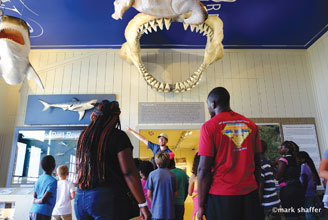
 “He saw the the natural beauty the sound had to offer,” says Hayward, “and immediately told Alicia he wanted to shoot an episode of his TV show here.” Among Cousteau’s many philanthropic and educational endeavors is the Emmy-nominated “Awesome Planet.”
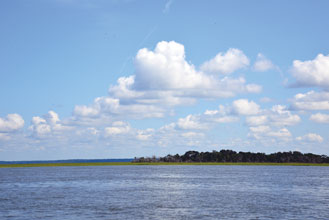
 the large intact marshlands. Clearly Port Royal Sound is a special place that has done a good job of protecting the wild places that make it so unique.
 Cousteau: This is one of the last healthy estuaries on the east coast. That is incredibly rare, unfortunately. As sea levels rise and more intense storms begin to hammer coastal areas, people will be very glad that they left some of the critical coastal and estuarine habitat intact to absorb the brunt of Mother Nature’s wrath. In addition, as healthy ecosystems become more and more rare they will be more and more valuable as a tourist attraction, which is good for the economy and jobs in the region.
 real responsibility to spearhead education in the community and ensure that we continue to enhance the ecosystem and stave off the kind of short term development that would enrich a few while impoverishing the many.