
| Gator Aid |
|
| Written by Mark Shaffer |
| Wednesday, 10 April 2013 13:59 |
|
Internationally recognized scientist to speak at Beaufort High.
Dr. Louis Guillette talks with Mark Shaffer about his groundbreaking research on the impact of toxic chemicals on the reproductive systems of alligators and humans.
Lou Guillette has a thing for gators. It just took twist of fate to figure it out. Soon after earning his PhD in Comparative Reproductive Biology at the University of Colorado he joined the faculty at the University of Florida where the only thing more ubiquitous than images of the toothy school mascot is the slogan, "Go Gators!" That was 1985. Within a year Guillette was blazing new trails in the study of the endangered Alligator mississippiensis, specifically its reproductive system. What began as a method of preserving a species has since evolved into a decades long study of the impact of toxic chemicals on wildlife and how this relates to humans.
Al Segars put me in touch with Dr. Guillette ("Call me Lou.") and I managed to find him on a day when he wasn't wrangling gators in the wilds of the Yawkey Wildlife Preserve near Georgetown. Mark Shaffer: How'd you get into gators, so to speak? Louis Guillette: I'm a reproductive Biologist/developmental geneticist by training. For 30 years I've been trying to understand how the reproductive system develops and how environmental factors influence the developing reproductive system and how that leads to birth defects – not the kind we normally think of, but ostensibly more subtle outcomes that could lead to infertility or cancer or whatever later in life. I arrived at the University of Florida in '85 and in '86 there was a knock on the door and there was a Fish & Game officer. He says the state's trying to figure out how to manage this endangered species, the American alligator, and there are people interested in breeding it and farming it and they understand very little about the reproductive biology of the beast, and could I help? It took us about four years to figure out the basic reproductive cycle and the broad details of basic management. I tell folks that the funny part is that the guy I worked with down there learned everything he knew about gators from some guys up here – Phil Wilkinson and Tom Murphy [with the SCDNR]. They worked out a lot of the details like how to catch an animal and let it go without getting eaten and that sort of stuff. And they even worked out specific details like how often does a specific female nest. In the late '80's we'd been working on seven different lakes in Florida concentrating of basic In 1980 there was a major pesticide spill in the lake – the last in a whole series of them. What we began to put together was that many of the environmental contaminants were not killing the animals or the embryos but altering their ability to reproduce. Over the last couple of years, what we've been able to show is that, at least at the gene level and the cell level, the abnormalities that we're seeing in these alligators (especially the females) is very similar to a number of diseases we see in human females. MS: We hear the term "chemical runoff" blamed for all sorts of things – particularly in an area full of golf courses and gated communities. But what you're finding out is that it's all about a much more complex series of chemical interactions. LG: I think you hit the nail on the head. This is why it's so difficult. I can't tell you that there's just one chemical to blame and that if you just ban this one chemical everything's going to be great. The problem is that it's the mixture of "all of the above." Historically, many of these chemicals are said to be safe. And yeah, they're safe if you're just interested in life or death, but they're not safe if you expose a developing embryo to them. MS: Of course, an alligator doesn't seek out chemicals. We do. We're exposed – and expose ourselves - to dozens over the course of the day. LG: Try hundreds. The CDC did a study that says on an average day there are a couple hundred chemicals that we either inhale, ingest or put on our skin – personal care products. MS: The simple gist of this is that what happens to an alligator who's just sitting there exposed to this stuff has a direct correlation to us. LG: Yes. If the environment's not safe for a baby alligator, it's not healthy for our babies. So, you're right. Now, the important thing to consider: is there a one-to-one relationship? In other words, does everything I see in an alligator, fish or frog happen to humans? Of course not. But the fact is if a red flag goes up you have to ask what that means for me.
MS: You've presented this research to Congress and all over the world. LG: I've presented it to Congress. In fact, our research was used as part of the support for the Food Quality Protection Act that was passed in 1997 that basically addressed contaminants in children's food especially. My mission is not to be anti-everything or anti-anything. I'm pro-children's health. We want healthy kids. I've testified before the European Congress for the European community and the Japanese Senate. Yeah, I'm asked on a regular basis to talk to government groups. MS: When you present to these groups do you generally find yourself dealing with a high level of skepticism? LG: A little bit or not, but quite honestly it's vested interest. Ultimately it comes down to vested interest. Some people are always skeptical, and that's perfectly okay. I'm a professional scientist. I'm the one going, "show me the data." And we have to think about the multiple interpretations of that data. People used to say, "that's a nice hypothesis." But we've done so much work over the past 15 or 20 years that it's no longer a hypothesis. We know that this is a fact. We know that this can happen. So now the question becomes what dose and what complexity of mixture do you have to have in order to get some of these effects. And then another important fact is why isn't everybody affected. That's the central question. There's always a vested interest, but I've never met a CEO of a company or anyone else who stands up and says, "I'm for birth defects." I think everyone's concerned about their kids and grandkids." SAVE THE DATE C.R.E.A.T.E. MORE:
|

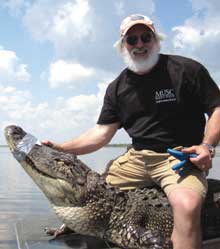
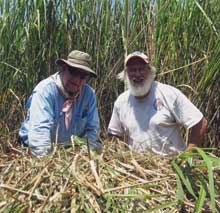
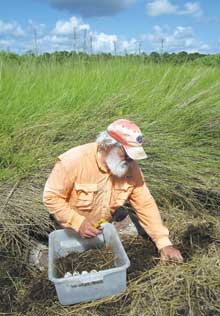 Today Dr. Louis Guillette Jr. occupies the Endowed Chair in Marine Genomics at the Medical University of South Carolina in Charleston and is an internationally recognized expert in comparative reproductive biology and developmental endocrinology. He's scheduled to speak April 18 at Beaufort High School. According to Dr. Alex Williams Bota, Science Department Chair at Beaufort High, the presentation was coordinated by the school's CREATE Club (Create Real Environmental Awareness Through Education) and local SCDNR biologist Dr. Al Segars. Guillette's research has helped to shape environmental law and policy all over the world and has special meaning for anyone living in the Lowcountry.
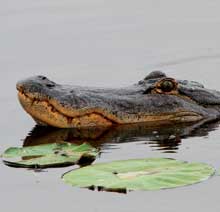 reproduction and hatch rates, working with the alligator farmers. And we started to notice that certain lakes produced really good eggs and others produced really bad eggs. Lake Apopka, just outside of Orlando, was particularly bad. The crazy part was that in the '40's and 50's Lake Apopka was one of the premier bass fishing lakes in the world. There were something like 21 fish camps. It was a multi-million dollar lake before there were multi-million dollar lakes. All of a sudden in the '80's there are no fish camps, nobody's fishing on the lake. It's basically a wasteland.
 Mosquito spray can kill you if you get a large enough dose. If I'm bigger than a mosquito it's going to take a lot more to kill me than a mosquito. But think about a developing embryo. Not only is it smaller but it's more sensitive. Every cell in its body is developing. Everything's growing and changing. And people say to me, 'Now wait a minute. Alligators don't look like me." The exact same genes that form the reproductive system in a human are in fact the same genes that form those same systems in an alligator. In the end product those systems aren't going to look anything alike, but at a gene level, at a cell level? I can show you pictures of a developing alligator egg and a developing human egg, and unless you really are an expert – and I've looked at thousands and thousands – I can start to show you differences, but they're subtle. And at the genetic level they don't really mean a lot.