
| Return of the Watermen |
|
| Written by Mark Shaffer |
| Wednesday, 13 March 2013 07:01 |
|
(Note: A version of this article first appeared in Lowcountry Weekly December 21, 2011.) THE MAN BEHIND THE MOLLUSK It's a crisp morning in late November on Brown's Island and the dock on Half Moon Creek, home base for Frank Roberts' Lady's Island Oyster Farm. A cold front blew through last night and took with it the clouds and humidity, scrubbing the air clean. The sky is bright turquoise. A light breeze only hints at what awaits out on the big water.
We're headed out to the mouth of the Coosaw River to look over part of Roberts' oyster farm. The sustainable operation is – as far as Roberts knows – the only one of its kind in South Carolina to actually grow select single oysters on a viable commercial scale. Roberts works closely with the South Carolina Department of Natural Resources and is currently involved in a study that could revolutionize oyster production in the state. Roberts is experimenting with growing sterile oysters. Unconcerned with the preoccupation for procreation, these mollusks grow twice as fast – mature at around seven months rather than fourteen. We snake out of Half Moon Creek and break out into Whale Branch, the bridge about a half-mile to We cross the mouth of the Beaufort River and into the waters of the Coosaw River. In the distance a coastline of maritime forest gives way to a vast savannah of salt marsh. The wet plains of spartina grass are a ruddy auburn. Summer's heady scent of necessary decay is gone. The air rushing over the bow smells of renewal – clean, sweet and salty. "I love going to work like this," Frank half-shouts over the engine. "There's nothing else like it." Like most days this is a two-man operation. We pick up Roberts' 1st Mate, family friend John Holden, and set about the task of pulling cages. THE OYSTER AND DANIEL WEBSTER Here in the Lowcountry oysters are part of our collective DNA, the literal "something in the water" that helps to set us apart as a culture. The first hint of a chill in the air means gathering around backyard fire pits to consume mass quantities of mollusks, a local feast that predates us by unknown millennia. The Sea Islands themselves took root on ancient oyster rakes. New archeological research indicates that pre-tribal native peoples harvested oysters en masse thousands of years before the first Europeans set foot on the continent. Oysters are a rich source of nutrition, high in protein and essential vitamins. Dozens of prehistoric dumpsites – oyster & clamshell hummocks – have been identified so far. Patterns suggest there may be hundreds more. When the Europeans did show up, they helped themselves to this natural bounty and literally built their New World settlements with material made from its crushed shell, a kind of primitive concrete called "tabby." Many of those ancient walls and foundations still survive. The oyster, howeve A tsunami of Oyster Mania swept the nation in the 19th century. At one point nearly every town boasted some manifestation of the craze. Oyster parlors, oyster cellars, oyster saloons, oyster bars and oyster houses were ubiquitous. The nation's oldest operating restaurant is Boston's Union Oyster House where both Daniel Webster and John F. Kennedy held court as regulars. I made certain that my wife's first raw bar experience took place at the same half moon bar where old Daniel consumed a daily lunch of six orders of a half dozen raw oysters with a tankard of watered brandy to wash each plate down. Little wonder he beat the Devil. As technology evolved, methods of harvesting became more industrial and more damaging. Demand exceeded supply. Little or no thought was given to management or conservation. Shellfish grounds once thought to be inexhaustible disappeared virtually overnight. An oyster is essentially one of Nature's most efficient filtration devices. A healthy and abundant oyster population means cleaner clearer water. Once that filtration system was virtually wiped out a perfect storm of environmental collapse was only a matter of time. In the Pacific Northwest over harvesting combined with disease destroyed Washington's entire native oyster population. On the East Coast the Chesapeake Bay imploded. The native oyster population still shows little sign of significant recovery after decades of management – some say less than 1% of its former peak. And in the Lowcountry a centuries old way of life was all but gone by the time JFK was in the Oval Office. SINGLES MATCH Frank Roberts developed his passion for oysters as a boy during summer visits to the family farm on Local wild oysters are traditionally harvested in clusters. The small portion of what ends up on the market as singles are actually separated from clusters. Roberts could literally taste the potential in producing a locally grown single that could take on the Blue Points and the Apalachicolas – the heavyweights of Eastern oysters. He'd studied and experimented widely with various methods over the years, up and down the coast but nothing seemed to work. "In the'80's I tried an early cage system but the technology wasn't there," he says. "They were made of pressure treated wood and galvanized metal and they eventually just fell apart." The cages may have failed, but while they held together the oysters flourished. Eventually the technology caught up with Roberts' imagination with the introduction of a coated wire mesh. "Then it was just a matter of finding the proper design for the racks and cages, getting the seed, convincing the bureaucrats to sign off on it and selling it to the public." As family and friends were drawn back to the Lowcountry, Roberts figured the time was right to pursue his dream. First sight of the headwaters of the Coosaw removed all doubt. "It all starts with an idea and goes from there. And Frank's got a great idea." Lee Taylor is a Biologist and Commercial Shellfish Coordinator with the South Carolina Department of Natural Resources. DNR and the Department of Health and Environmental Control both monitor and manage different aspects of the commercial shellfish industry. Taylor calls Roberts one of the most responsible fishermen in the industry. "He's just got the mindset. He puts back more than he takes," he explains. "He's constantly improving the area around him even when it's not required – way above and beyond the minimum requirements. And he does it just because he enjoys doing it." There's a word for that: stewardship.
Each cage contains up to nine individual mesh bags of singles and can weigh around 600 pounds. Boating this monster is a tricky process, particularly in choppy water and with the constant threat of wakes from passing traffic on the Intracoastal. Once on board the cage is opened, bags are pulled, rotated and inspected while some are sorted and harvested. A few are marked with brightly colored zip ties to indicate a project. It's a constant learning process. It is a labor intensive, physically demanding process on an unstable platform. "He might have a cage that's growing really well and try the area right next to it and it just won't do," says Taylor. "He's learned through trial and error what works and where. The variables are almost endless." "Just because you have an oyster lease doesn't mean you can go out and do this," says Frank. "You need certain conditions and topography of the sea floor and creeks to make it work." There are also different techniques for different areas. Roberts is getting good results with a floating bag system in tidal creeks with little or no boat traffic. A long-running experiment using bamboo poles to form a kind of oyster grove is beginning to pay off. The method has been used for centuries in China. The last cage is carefully lowered back into position. John disengages the grapple hook with a couple "Our customer reaction has been terrific," says Silo's David Hislop. "Universally, people who have tried his oysters say that they're the best they've ever had. I've never really been a big raw oyster fan, but I could seriously eat 40 or 50 of his at a time." Hislop says the Lady's Island Oyster Farm fits right in with Silo's concept of buying local and direct from the producer. "Frank grows his oysters in a sustainable way and Silo is all about supporting sustainable products," says Hislop. "We want to get the best, freshest, cleanest local product possible into the hands of the consumer at the lowest price possible and that's what we're doing." "Specifically what Frank's doing is honing in on the only piece of our shellfish market that's being imported," says Lee Taylor, "He wants to compete with Gulf singles which is fantastic if he can do it. The more in-state product the better for our industry." "Here in Beaufort we've been used to clusters," says Frank. "But everyone I spoke to years back was very clear – you grow a single oyster here and people will come. I get them at the farmer's markets all the time – people from Florida, Louisiana, Mississippi, Maryland, and New York – people who swear by the Apalachicolas and the Blue Points. They all leave with the same response: best damn oyster I ever had." Ditto.
OYSTER KNIVES 101
"It's got a good grip," he says, "but the key is the curved tip of the blade which let's you get into the oyster clean with minimal shell damage." Frank gets his for about $6 at Beaufort Marine Supply in Shell Point (843-525-1611). But be warned, says Frank, these knives work so well "they tend to walk away on their own." ETCETERA Frank Roberts' Single Lady Oysters are available through www.silo-beaufort.com and http://singleladyoysters.com. Email Frank for more info at
This e-mail address is being protected from spambots. You need JavaScript enabled to view it
|
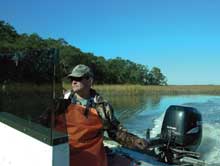 Frank Roberts' Lady's Island Oyster Farm brings a sustainably harvested oyster to the Lowcountry and hope for the revitalization of a lost way of life.
 Frank Roberts preps the boat as a pair of bottlenose dolphin fish near the creek bank just a few feet away. Roberts' dog, Jack, cocks his head as they cruise past the dock and disappear into the sun's molten mercury reflection on the rippling current.
 starboard. We turn in the opposite direction to make for the Coosaw. Out on the open water a westerly wind beats the incoming tide to a rough chop. A mini-armada of snowbirds in vessels of all descriptions dots the horizon in a southerly caravan on the Intracoastal Waterway toward winter berths in warmer climes.
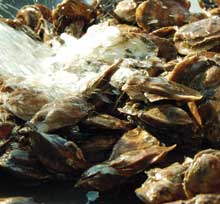 r, has had a rough go.
 the shores of the Chesapeake, land originally granted by King George II. As a young Marine on Parris Island, Roberts looked out over the tidal rivers and salt marshes and saw unlimited potential.
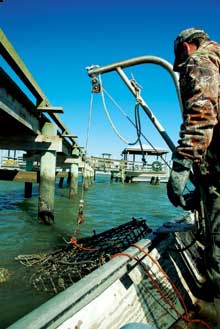
 Back on the water Frank maneuvers the boat into position while John lowers the boom (hence the term) and snags a cage with a grapple line. These cages are sheltered under a private pier by agreement with the owner. Frank's also been rebuilding the natural beds in front of the property, a project that will eventually yield a wild harvest and protect the shoreline from erosion.
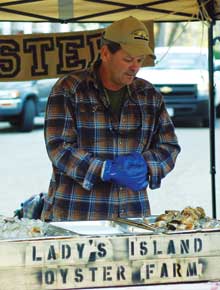 of tugs on the line. The boom is raised and secured. The morning's harvest is ready for market in a bright orange bushel basket. Most of this batch is headed to fill orders made online through silo-beaufort.com. Each Friday Frank drops the orders at the Silo storefront in Habersham and then sets up his booth at the Farmer's Market. Saturday mornings he's at the Port Royal Farmer's Market. It's all part of getting the word out, building a buzz and creating a niche market.
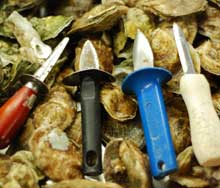 Prying open a live oyster is a completely different task than shucking steamers. You need a quality tool for the job to avoid making a mess of the mollusk as well as your hands. But choosing the right oyster knife can be a challenge as they vary drastically in style, quality and price. One of Chris Williams'custom Edisto blades made in the Upstate will set you back a chilly $250 (www.williamsknife.com), but they're just too damned pretty to use. Frank Roberts recommends a New Haven Knife (pictured far right, white handle).